
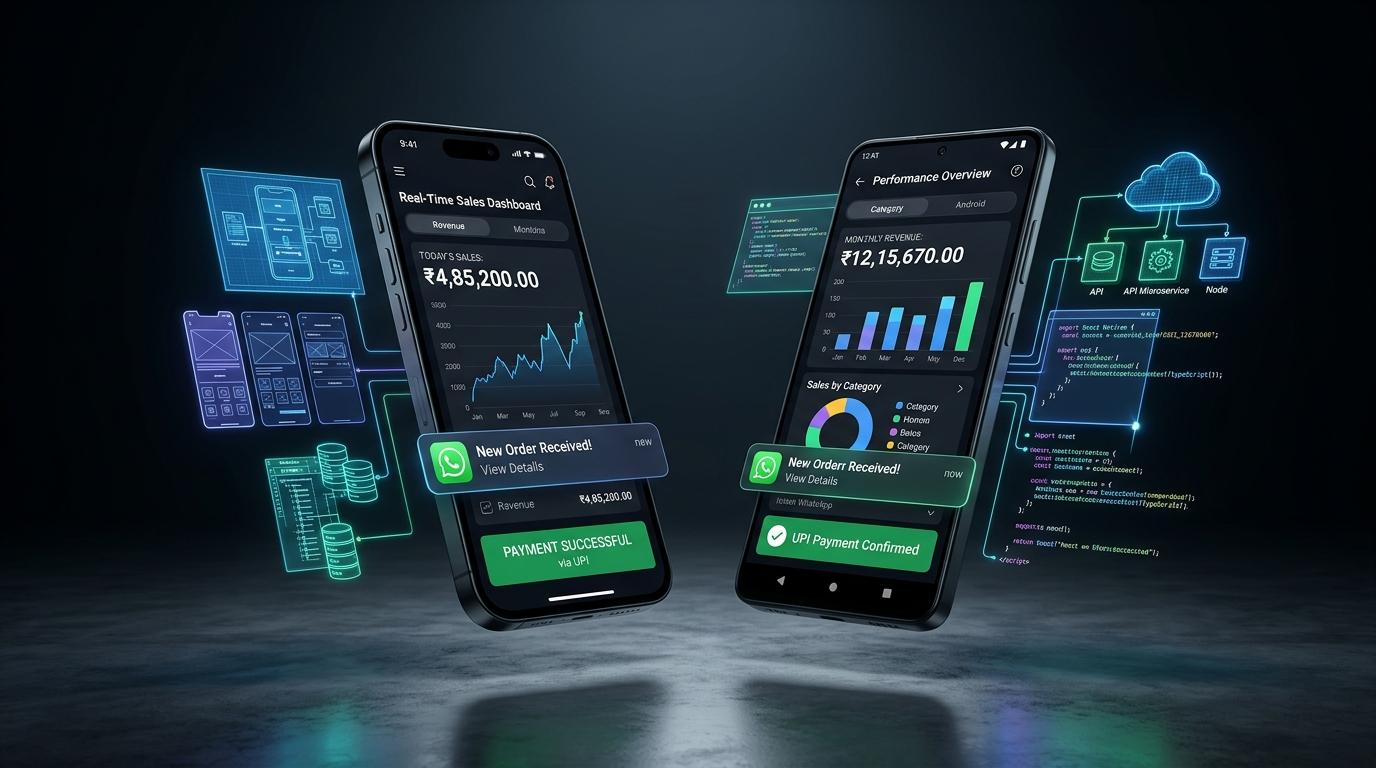
Discover why custom mobile app development outperforms DIY builders for Indian small businesses. Scale your brand with high-performance, owned software solutions in 2026.
The Real Cost of Mobile Presence for Indian Small Businesses
A fabric shop in Surat takes dozens of orders daily over WhatsApp, tracks them in a paper register, and pays hefty 25–30% commissions to aggregator platforms for the handful of customers it didn't already know. The owner has a mobile presence. He just doesn't own it.
That is the App Gap. Local businesses and growing D2C brands across India are already operating on smartphones — taking orders, processing UPI payments, coordinating delivery boys, and managing customer follow-ups. Yet, the software layer running those transactions belongs entirely to third parties. Every repeat customer is routed through a platform that can arbitrarily hike platform fees, bury your listing beneath sponsored competitors, or delist your catalog overnight.
Consumer behavior leaves no room for debate:
- 91% of smartphone users rely on mobile-first commerce — daily trade, bill payments, and services have permanently reorganized around mobile handsets.
- Over 40% of active buyers are online almost constantly, meaning an Indian merchant without a dedicated, direct mobile channel remains invisible for the majority of their customers' day.
An app is not a marketing expense or a vanity project. When engineered correctly, it is a balance-sheet asset — an owned piece of intellectual property with your customer data, transaction history, proprietary pricing rules, and automated workflows sitting securely inside it. Whether that asset appreciates over the next three years depends on how you build it today: renting fragile no-code blocks or engineering custom software you own.
DIY App Builders vs. Custom Development: The Ownership Trap
Many founders first explore drag-and-drop tools like Bubble, Adalo, FlutterFlow, or Appy Pie. While tempting for quick mockups, no-code builders hit an impenetrable brick wall the moment your operations require localized Indian business logic.
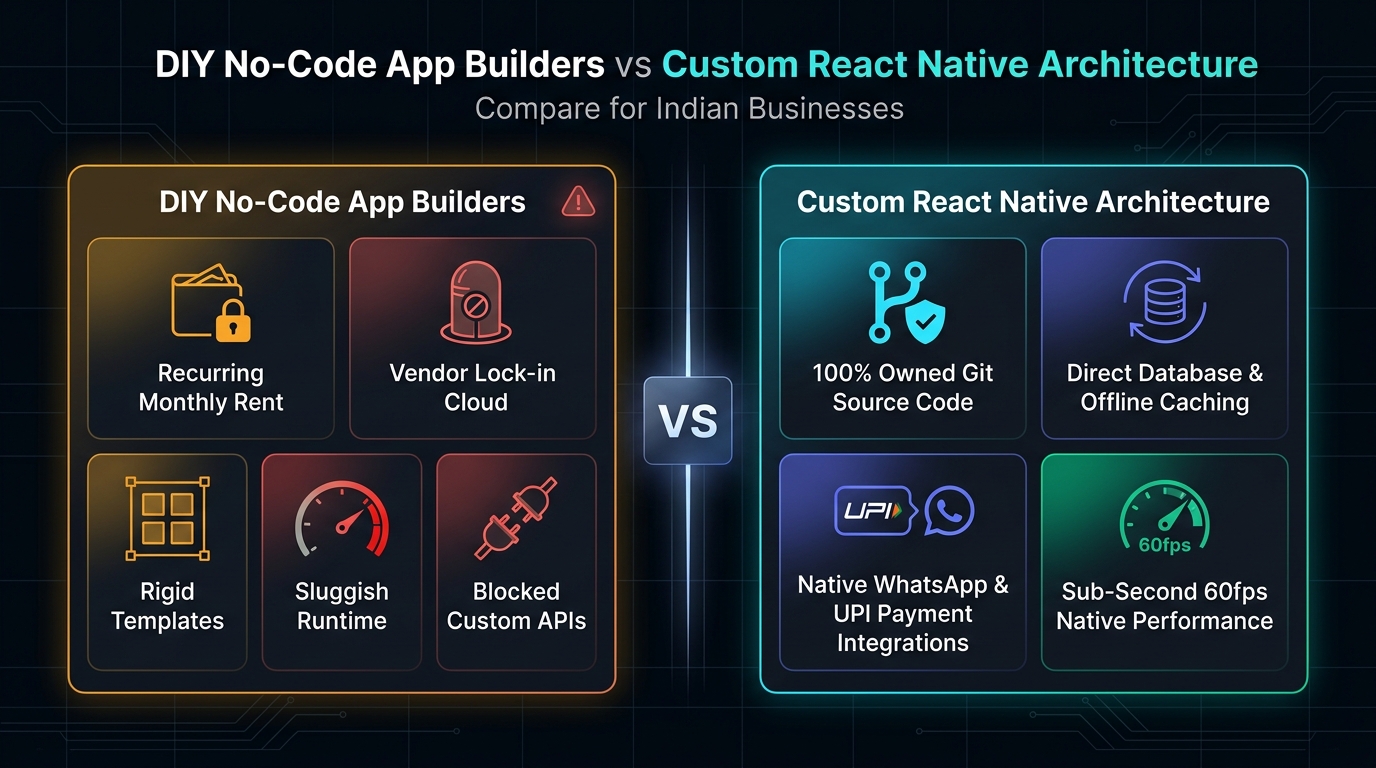
| Operational Criteria | DIY No-Code App Builders | Custom Mobile App Development |
|---|---|---|
| Cost Structure | Monthly subscription forever; exponential pricing tiers as user records and database hits grow | One-time sprint investment, followed by predictable cloud hosting costs |
| Code Ownership | Platform owns the proprietary runtime; you rent access to your own business logic | 100% source code ownership; Git repository transferred directly to your account |
| Data Sovereignty | Trapped in vendor-locked proprietary silos; export options are truncated or non-existent | Direct PostgreSQL / MongoDB access with automatic local backups and zero lock-in |
| API & Hardware Integration | Restricted to vendor-approved plugins; cannot run custom native bridges or background sync | Full native device access (Bluetooth POS printers, barcode scanners, background GPS) |
| India-Specific Automation | Stumbles on automated WhatsApp webhooks, split-settlement Razorpay/Cashfree, and multi-tier GST | Seamless 2-way WhatsApp Business API, instant UPI deep-linking, and automated GST billing |
| Performance & Offline | Web-view wrapper overhead; sluggish cold-starts (3–5s) and fragile offline behavior | Native 60fps React Native performance, instant startup (<800ms), and robust offline caching |
Platforms like Bubble and Adalo excel at two-week prototypes to test basic consumer appetite. But as permanent business infrastructure, they fail on day one of actual scale. The moment you need a bi-directional WhatsApp automation that updates inventory from your warehouse table, or an Indian payment gateway split-payout between a merchant and a local courier partner, no-code builders break down.
Furthermore, ownership is where financial impact hits. When an Indian bank evaluates your company for a collateral-free working capital loan, or an investor conducts financial due diligence, they inspect balance-sheet assets. A subscription login to a no-code SaaS is an operational liability. A clean Git repository containing custom business logic, integrated with your proprietary databases, is demonstrable equity. Building bespoke custom software and automation transforms recurring software rent into enterprise value.
The 14-Day Launch: Moving at the Speed of an Indian Founder
The primary reason founders hesitate to commission custom software is the trauma of traditional agency timelines: six-month development marathons, dozens of bloated slide decks, and three rounds of wireframe renegotiations.
At Cloud Ninja Dev, we reject traditional agency bureaucracy. Through our proven 14-day delivery sprint, we launch production-grade mobile applications with laser-focused discipline:
- Days 1–2: Business Logic Mapping. We skip generic wireframes and trace how orders, cash, and goods physically move through your business today. We identify the exact high-friction manual steps the app must automate.
- Days 3–4: MVP Scope Lock. We lock one core transaction engine — such as instant catalog ordering with WhatsApp notifications or direct technician booking. Secondary nice-to-haves are staged for version two.
- Days 5–10: Native Engineering Sprint. Utilizing cross-platform React Native, we write one robust TypeScript codebase that compiles into native iOS and Android binaries simultaneously, cutting delivery times in half without sacrificing native responsiveness.
- Days 11–12: High-Stakes Integrations. We wire up local Indian payment gateways (Razorpay, Cashfree, PhonePe), configure the WhatsApp Cloud API, and synchronize data with existing ERP or inventory systems (learn more in our guide on why off-the-shelf inventory software fails Indian retailers).
- Days 13–14: Rigorous End-to-End Testing & Store Submission. We run regression checks on multiple physical Android and iOS handsets, test network dropouts (2G/3G edge cases), and submit compliant builds to the Google Play Console and Apple App Store.
Throughout this process, you talk directly to the software engineer writing your code. No non-technical account managers, no relay games, and no translation loss.
Modern development tools amplify this speed: IDC estimates that over 35% of engineering teams leverage GenAI to co-develop robust enterprise software, and Gartner projects that 40% of commercial mobile applications will feature autonomous AI agents by the end of 2026 (explore our AI automation solutions to see how intelligent agents augment customer service).
Budgeting for Reality: Maintenance and Cloud Operating Costs
Any agency that hands over an application and disappears without addressing year-two operational realities is setting you up for failure. A healthy mobile application requires structured maintenance — not as a penalty, but as the routine cost of keeping digital infrastructure resilient.
Here is where production app budgets actually go:
- Cloud Server & Database Hosting: Scalable cloud compute (AWS, Google Cloud, or Supabase). A regional Indian retail app serving several thousand active monthly customers typically incurs modest hosting bills when database queries and serverless workers are properly indexed.
- Third-Party APIs & Gateways: Indian SMS DLT routing, WhatsApp Business API utility conversation rates, Google Maps geocoding, and payment gateway MDRs.
- Operating System Updates: Apple and Google roll out major OS updates annually (iOS 19, Android 16). Neglected apps quickly encounter deprecated native libraries, rendering bugs, and eventual store delisting.
- Bug Fixes & Security Hardening: Patching security dependencies, updating TLS certificates, and ensuring customer data remains safeguarded under Indian data privacy regulations.
- Iterative Feature Evolution: Adding customer loyalty tiers, Hindi/Tamil language localization, or automated supplier re-ordering (read how custom integrations eliminate friction in our breakdown of generic CRM failures for Indian businesses).
Pro-Tip on Cost Optimization: Third-party API charges scale with careless code, not with user volume. By caching geocoding responses, batching push notifications, and performing customer verification via WhatsApp deep-links rather than expensive SMS OTPs, an optimized custom architecture slashes monthly operational overhead by up to 70%.
Navigating the Gatekeepers: Apple App Store and Google Play Approval
Store rejections cause costly launch delays. Passing review on the first submission requires strict adherence to developer guidelines:
Apple App Store (iOS Review Guidelines)
- Human Interface Guidelines (HIG): Smooth native navigation hierarchies; Apple strictly rejects clunky web-view wrappers disguised as native apps.
- Sign in with Apple: Mandatory if your application offers third-party social logins (Google, Facebook).
- Privacy Nutrition Labels: Comprehensive disclosure of all collected data points (contact info, financial identifiers, precise location).
- Functional Test Credentials: Active demo credentials and pre-loaded test data provided in the review notes.
- In-App Purchase (IAP) Rules: Clear distinction between digital goods (requiring Apple IAP) and physical merchandise/services (which safely use Indian UPI and payment gateways).
Google Play Store (Android Review Guidelines)
- Material Design Navigation: Native back-button handling, intuitive drawer or tab bar patterns, and clean typography.
- Data Safety Section: Complete parity between declared permissions in your manifest and real-world runtime behavior.
- Target SDK Requirements: Must target the latest Android API levels to guarantee sandbox security and runtime permissions.
- Prominent Privacy Policy: A publicly accessible, SSL-secured privacy policy clearly detailing data collection, storage, and customer deletion protocols.
Both app stores enforce complete commercial transparency. If your app offers paid services or products, prices, terms, and delivery expectations must be clearly visible before checkout. Hiding fees or requiring convoluted phone calls before displaying pricing guarantees immediate store rejection.
5 Critical Questions to Vet Any App Development Partner
Before signing a contract with any agency or freelance team, demand written clarity on these five points:
- Who owns the source code on Day 1, and will you push commits directly to my Git repository? If they retain intellectual property or charge a "code buyout fee", walk away immediately.
- Will you provide a fixed-price, fixed-scope contract for the MVP? Open-ended hourly billing on an early-stage app invites scope bloat and budget overruns.
- Do I communicate directly with the engineer writing the software? Intermediaries dilute technical clarity and slow iteration cycles.
- Which cloud, developer, and gateway accounts will be used? Every account — AWS, Google Play Console, Apple Developer Program, Razorpay, WhatsApp Cloud API — must be registered in your business's legal name.
- How are cross-platform web and mobile experiences synchronized? If you also operate a web portal or customer dashboard, verify that the mobile app shares APIs with your modern web development infrastructure.
Frequently Asked Questions (FAQ)
Why do DIY no-code app builders end up costing more for Indian businesses?
No-code builders charge recurring monthly subscriptions that escalate sharply as your user records, database operations, and monthly active users grow. More critically, they lack native support for Indian payment splits, WhatsApp conversational commerce, and local hardware. When you outgrow the platform, you cannot export your code — forcing a complete rewrite from scratch and resulting in thousands of wasted dollars.
Can a production-ready custom mobile app really be built and launched in 14 days?
Yes. By adopting a disciplined MVP scope, utilizing cross-platform React Native for simultaneous iOS and Android builds, and leveraging pre-tested architectural components for UPI payments and authentication, Cloud Ninja Dev routinely delivers production-ready applications within two weeks.
What does 100% code ownership mean for my business valuation?
100% code ownership means the entire Git repository, database schema, architectural blueprints, and intellectual property are legally transferred to your company. When presenting your financials to banks for business loans or discussing equity investments with venture partners, your software is categorized as an owned intangible asset rather than an ongoing operational liability.
Will our custom mobile application pass Google Play and Apple App Store reviews?
Yes. We architect every mobile build to comply strictly with Apple's Human Interface Guidelines and Google's Material Design standards. We handle the Data Safety filings, Privacy Nutrition declarations, and store asset preparation to ensure smooth, first-pass approval.
Launch Your Custom Mobile App in 14 Days with Cloud Ninja Dev
The dilemma isn't whether your business needs a mobile footprint — your customers are already demanding one. The real decision is whether you want to rent a restrictive third-party platform or own an engineered, high-performance asset built specifically for your bottom line.
Cloud Ninja Dev engineers production-grade mobile applications with 100% code ownership, sub-second performance, and seamless Indian payment and WhatsApp automations. You work directly with senior full-stack developers who understand both high-performance code and commercial profitability.
Ready to eliminate third-party commissions and take control of your mobile channel?