
Stop losing sales and margin to manual workflows. Discover why custom business automation beats expensive SaaS subscriptions for Indian small businesses in 2026 with 100% code ownership and zero monthly lock-in.
The Hidden Cost of Manual Workflows in Indian Retail
It starts at 9:00 AM with a customer sending a WhatsApp message asking whether a product is in stock. By noon there are forty unread chats, three missed phone calls, a half-written physical bill book, and a high-ticket order promised to a regular customer who never received an official confirmation. No one logged it into a system. No one remembered it. By 3:00 PM, that customer placed an order on a quick-commerce app instead.
That is the true cost of manual workflows in Indian commerce — not just the wasted hours spent typing on a mobile screen, but the silent, continuous revenue leakage:
- The Visible Errors: A wrong total on a handwritten invoice or a misplaced paper bill gets caught at the billing counter after ten minutes of uncomfortable argument with the shopper.
- The Silent Leaks: A high-intent inquiry that was never answered within ninety seconds gets caught by nobody. The buyer silently disappears, customer trust quietly erodes, and store owners never learn why repeat footfall dropped.
Small businesses are moving decisively to fix this structural bottleneck: small business AI investment rose to 57% in 2026 — a clear signal that Indian merchants and distributors are no longer treating workflow automation as an optional experiment. Crucially, the operational time returned by automation is not idle: 59% of small business workers reinvest automation time savings into higher-value customer service and inventory acquisition.
Automation is not about stripping the warm, personal relationship away from Indian retail. It is about automating low-level clerical repetition so you and your team can focus on relationships that generate revenue. The decisive strategic question is whether you rent that efficiency from a rigid SaaS subscription or own the digital engine outright.
Why WhatsApp is the Operating System for Modern Indian Business
Ask an independent retailer or wholesale distributor in Pune, Ahmedabad, or Coimbatore where their customer transactions actually happen, and nobody points to email. Orders arrive as quick voice notes in Hindi or Tamil. Payment receipts arrive as mobile screenshots. Reorders from loyal accounts arrive as a single colloquial word: "same".
An email-centric CRM or off-the-shelf Western SaaS asks your local buyers to alter their daily habits to suit rigid software forms. Bespoke AI automation solutions built around official WhatsApp APIs work in reverse — the software meets your customers where they already live every day.
What resilient automation looks like inside a high-volume Indian shop:
- Frictionless Lead Capture: A website inquiry, Google Maps click-to-chat, or QR scan drops straight into an automated WhatsApp thread with the customer's name and exact SKU preference attached. Staff never have to retype phone numbers into spreadsheets at 10:00 PM.
- 24/7 Conversational Storefront: An automated conversational assistant handles high-frequency repetitive questions — live stock checks, festival holiday hours, delivery coverage pincodes, and dynamic payment links — answered at 11:00 PM on Sunday without waking the owner.
- Owner Telemetry on Mobile: Critical operational alerts — low-stock warnings, counter cash reconciliations, and overdue credit (khata) reminders — arrive directly on the owner's personal phone via direct WhatsApp pings.
The bottom-line results mirror the operational speed: small businesses adopting tailored AI and automation workflows report 18% to 25% sustained operating cost reductions.
Custom Software vs. SaaS: The Case for Code Ownership
Subscription fatigue is mathematical reality, not subjective opinion. Renting five disconnected cloud tools at ₹2,500 to ₹8,000 per seat each month means paying a compounding tax for software features your business utilizes less than a third of. At the end of five years, your business holds zero owned digital equity.
The comparative breakdown below highlights the strategic divide between leasing generic SaaS and owning a bespoke automation system:
| Strategic Metric | Generic SaaS Subscriptions | Custom Automation Engine (Cloud Ninja Dev) |
|---|---|---|
| 5-Year Financial Shape | Perpetual recurring fees that escalate with order volume & staff seats | One-time engineering build cost; only bare metal hosting thereafter |
| Code & Asset Ownership | Vendor owns source code, data formats, and business workflow rules | You own 100% of the intellectual property, database, and codebase |
| Workflow Adaptability | Your store must alter its operations to fit rigid vendor product roadmaps | The software is custom-engineered to match your exact counter workflow |
| Messaging Integration | Fragmented third-party connectors with steep per-message price markups | Direct Meta WhatsApp Cloud API connection with zero middleware fees |
| Support & Issue Resolution | Anonymous ticketing queues with multi-day turnaround times | Direct access to the dedicated full-stack engineer who architected the system |
| Data Privacy & Control | Customer order logs and phone records stored on multi-tenant foreign clouds | Dedicated self-hosted database (PostgreSQL/SQLite) completely under your custody |
Code ownership is the single most undervalued asset in small business strategy. Investing in custom software and automation is a capital asset that appreciates alongside your business. The proprietary logic governing how your shop extends customer credit during festival rush, how loose wholesale items are packaged, or how return merchandise is handled becomes your defensible competitive moat.
With modern engineering stacks, rapid deployment eliminates historical delays: a production-grade, customized system can be architected and deployed in 14 days. Global business surveys prove the leverage: 25% of commercial leaders report that AI and custom automation are having a transformative impact on their enterprise efficiency.
Defensive Automation: Handling Errors and Data Conflicts
An automation pipeline that crashes loudly is an annoyance; one that fails silently is an existential business liability. If a WhatsApp order webhook drops during a broadband hiccup and your software lacks error handling, an order simply vanishes — leaving an angry customer wondering why their delivery never arrived.
Production-grade custom automation is defensive by design:

Core Defensive Engineering Principles:
- Establish the Failure Path First: Before writing code for the standard "happy path," we build automated retry queues with exponential backoff and dead-letter queues (DLQ). Every database write touching inventory balances or UPI transactions logs its operational state. If an external API drops connection, the task retries without human intervention and notifies the owner if three retries fail.
- Find or Create (Never Blind Create): When capturing customer interactions, the engine matches against stable primary identifiers (normalized 10-digit mobile phone numbers or GSTINs). It updates existing relational records rather than spawning fragmented, duplicate customer entries.
- Strict Idempotency: Every transaction payload carries an immutable idempotency key. If a customer double-taps a payment link or a network timeout causes a webhook to re-trigger, the engine processes the event exactly once, eliminating double-charging or double-decrementing stock.
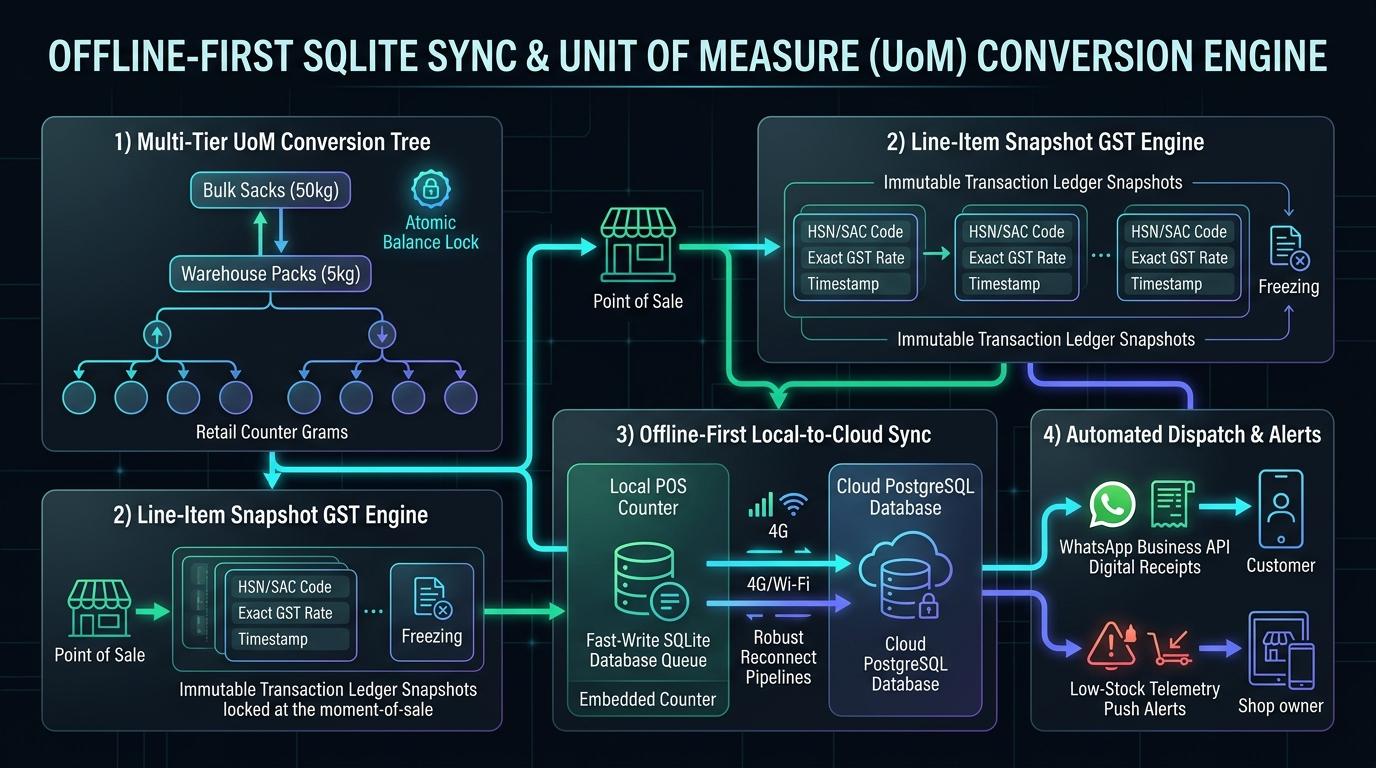
- Single Source of Truth: Rather than letting fragmented SaaS tools debate customer records, the architecture establishes a central PostgreSQL or SQLite database as the master ledger. Secondary services read from this master source, preventing conflicting inventory balances.
The Human-in-the-Loop: When to Stop the Bot
World-class automation recognizes its operational boundaries. Human-in-the-loop engineering intentionally defines the exact thresholds where the software must pause and defer to human judgment rather than executing unchecked actions:
- Discount Protection Floors: A WhatsApp bot can distribute pre-approved promotional coupons. It must never negotiate prices autonomously. Any discount request exceeding a defined percentage stops immediately and routes to the store owner's personal WhatsApp for one-click approval — preserving retail gross margins.
- High-Ticket Quotation Thresholds: Define a strict rupee ceiling (e.g., orders above ₹25,000). Above that figure, the automated engine compiles the draft quotation, reserves stock temporarily, and holds the order for owner confirmation. Large bulk orders carry credit terms and transport logistics that require personal oversight.
- Customer Sentiment Escalation: If a buyer repeats a question three times, uses urgent frustrated phrasing, or reports a damaged delivery, the automated system disengages immediately. A chatbot repeating canned apologies amplifies frustration; an instant alert that summons a store manager fixes the relationship immediately.
These guardrails must be encoded into the application logic during initial development, not retrofitted after an embarrassing customer incident.
Launching Your Custom Automation in 14 Days
Transitioning from manual counter chaos to a fully owned digital automation engine does not require months of enterprise IT disruption. We execute a disciplined 14-day production sprint:
| Sprint Timeline | Engineering Milestones & Deliverables | Operational Impact for Store Owners |
|---|---|---|
| Days 1–3: Workflow Audit | In-depth diagnostic of your physical counter workflows, billing procedures, and customer communication bottlenecks | Identification of high-frequency repetitive tasks and unified data schema design |
| Days 4–8: Core Engine Build | Official WhatsApp Cloud API integration, PostgreSQL database setup, and custom business logic implementation | Automated catalog browsing, instant lead capture, and defensive error-handling queues |
| Days 9–11: Defensive Testing | Real-traffic edge case simulation, network failure recovery testing, and threshold escalation validation | Verified zero-duplicate order processing, safe discount limits, and instant UPI reconciliation |
| Days 12–14: Deployment & Handover | Full production deployment, staff walkthrough, and delivery of 100% source code and access credentials | Autonomous store operations live; permanent elimination of recurring SaaS subscription fees |
Throughout the entire two-week cycle, you collaborate directly with the senior full-stack engineer building your software — bypassing agency layers, junior account managers, and endless ticket queues.
Frequently Asked Questions
Why is custom automation more reliable than chaining tools together with Zapier or Make?
Third-party iPaaS platforms like Zapier charge escalating per-task fees, enforce rigid rate limits, and introduce multiple points of failure. If one tool alters its API schema, the entire workflow breaks silently. A custom-built engine uses direct API webhooks, atomic database transactions, and persistent retry queues, delivering 99.9% uptime at a fraction of the operating cost.
How does owning the source code benefit my retail business long-term?
When you own the source code, you possess an intellectual property asset that resides directly on your balance sheet. You are never subject to surprise vendor price increases, forced UI migrations, or arbitrary account suspensions. Any developer can maintain or expand your system as your business scales.
Can custom automation integrate with our existing desktop accounting or billing software?
Yes. Custom software can bridge legacy desktop applications (such as Tally or offline POS databases) using lightweight local synchronization agents that securely exchange data with cloud PostgreSQL or WhatsApp webhooks, eliminating manual double-entry. For an in-depth breakdown, read our guide on why custom billing and stock management apps beat generic SaaS.
What ongoing costs are required after the initial 14-day build?
Unlike SaaS subscriptions that charge per user and per month indefinitely, custom software only incurs minimal bare-metal infrastructure costs (typically ₹500 to ₹1,500 per month for managed cloud hosting or database instances) and direct wholesale Meta WhatsApp API usage without vendor markups.
How does custom WhatsApp automation prevent customer double-messaging?
By enforcing database-level idempotency keys and stateful CRM flags, the system tracks conversation state in real time. Once an inquiry is acknowledged or a customer service agent joins the chat, automated bot replies pause automatically, preventing contradictory duplicate messages.
Build an Asset You Own
Continuing to run high-volume retail operations through manual chats and paper notebooks caps your growth at the number of hours your counter staff can physically work. Renting generic SaaS subscriptions drains your operating margins while locking your customer data inside closed vendor gardens.
A tailored custom automation system gives your business a resilient digital storefront that captures leads 24/7, reconciles payments instantaneously, and prevents costly clerical errors — built entirely on technology you own outright.
Explore our custom software and automation services and AI automation solutions to review recent case studies. Discover our transparent direct-to-engineer process, or contact Cloud Ninja Dev today to schedule your custom workflow audit.