
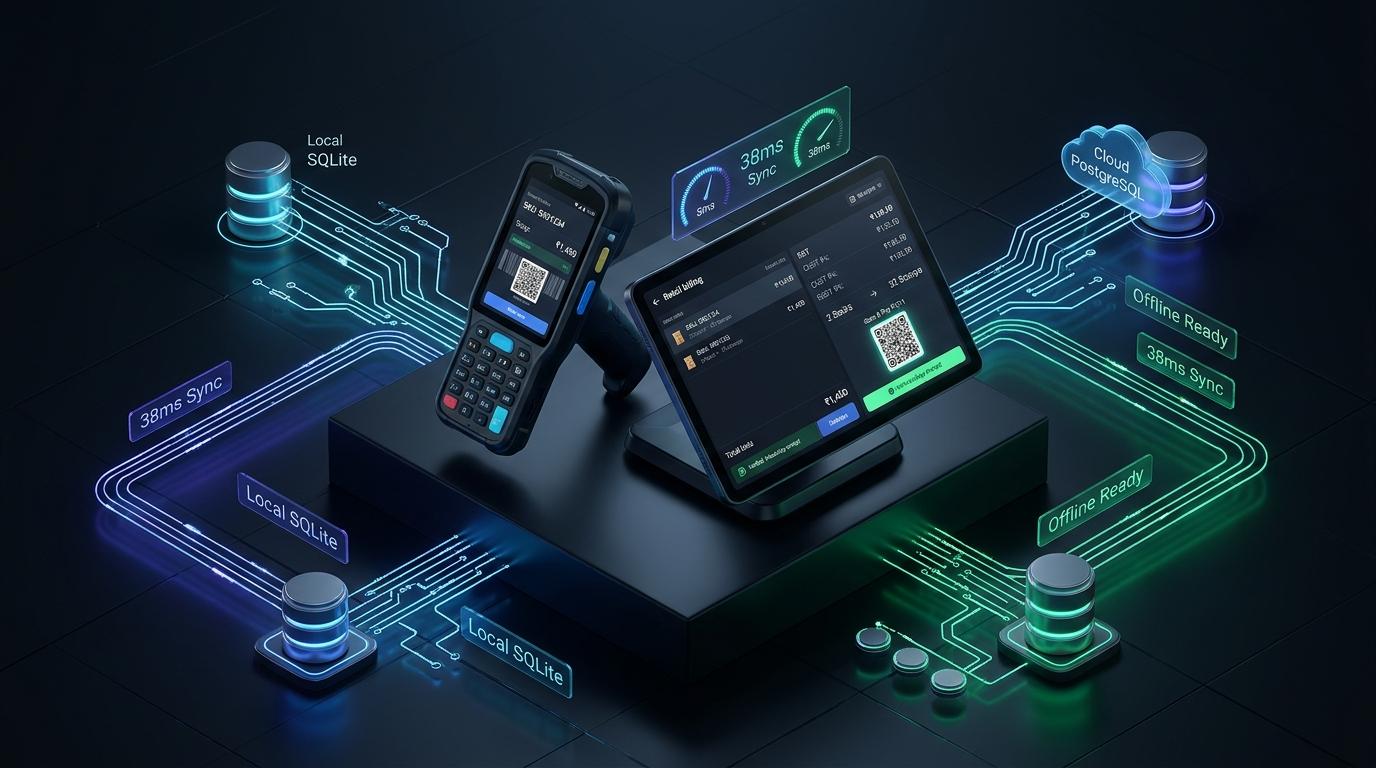
Stop overpaying for rigid, generic software subscriptions. Discover why custom billing and stock management apps provide Indian retailers with offline-first reliability, eliminate phantom inventory, and deliver long-term balance-sheet equity in 2026.
The Hidden Cost of Rigid Billing and Stock Management Apps
A busy kirana merchant or wholesale distributor in Pune operates three disconnected software tools to manage a single physical counter: one for barcode billing, one for godown stock tracking, and a third for manual customer messaging.
None of these platforms synchronize in real time. As a result, the retail enterprise is forced to compromise its own operational workflow — how promotional combos are assembled, how loose bulk commodities are weighed, and how customer credit (khata) ledgers are reconciled — simply to accommodate generic software engineered for a foreign retail environment.
That operational compromise is the hidden tax of commercial SaaS:
- Monthly Subscriptions Buy Access, Never Equity: Years of continuous recurring payments leave the retailer with zero owned intellectual property, zero source code rights, and no ability to customize a single business logic rule.
- Disconnected Messaging Channels: Global SaaS platforms lack native WhatsApp Business Cloud API integration, forcing staff to manually send PDF invoices and payment reminders from personal phones outside the system.
- Supply Chain Vulnerability: Cybersecurity and data custody are the primary concerns for 55.6% of businesses when assessing supply chain resilience — and rented, multi-tenant cloud software is where merchants have the least architectural control.
The global billing and invoicing software industry is projected to surge to $12.06 billion in 2026, underscoring how much economic value is captured by software platform vendors rather than the business owners using them. The decisive question for modern retailers is whether investing in bespoke custom software and backend automation costs significantly less over five years than perpetually leasing an ill-fitting generic tool.
Code Ownership: A Critical Balance-Sheet Asset for Indian Founders
Owning your software codebase fundamentally transforms the unit economics of business growth:
- Zero Per-Counter Licensing Taxes: Add second-counter billing stations, godown warehouse tablets, or remote delivery staff accounts without paying escalating per-seat monthly penalties.
- Immunity to Arbitrary Price Hikes: SaaS providers routinely revise tier pricing or deprecate legacy features upon contract renewal. Owned software operates under your complete control.
- Capitalized Enterprise Equity: An owned, custom-engineered software asset appears directly on your corporate balance sheet as proprietary intellectual property. When securing collateral-free working capital loans or planning equity dilution, an owned operations engine is a tangible asset buyers can independently audit and value.
Operational Comparison: Rigid SaaS Subscription vs. Custom Code-Owned Build
| Operational Metric | Commercial SaaS Subscription (Zoho, Vyapar, Marg) | Custom Code-Owned Build (Cloud Ninja Dev) |
|---|---|---|
| Capital Allocation | Recurring monthly rent that scales per counter and user | One-time 14-day sprint investment; minimal hosting only |
| Workflow Adaptability | Your staff must warp their processes to fit rigid vendor UI | Software is engineered around your exact counter workflow |
| Data Custody & Export | Stored on vendor's shared cloud; restrictive CSV exports | Direct PostgreSQL / Supabase access with automated backups |
| Hardware & Peripherals | Strict compatibility limits on thermal printers & weigh scales | Native hardware hooks for any USB/Bluetooth scanner or scale |
| India-Specific WhatsApp | Unofficial scraper add-on or expensive third-party connector | Native Meta Cloud API integration with automated receipts |
| Balance-Sheet Value | $0 (Unrecoverable operating expense) | 100% Owned Intellectual Property & Business Asset |
Solving the 'Phantom Inventory' Problem with Custom Logic
"Phantom inventory" describes the chronic operational disaster where your software dashboard reports items in stock, but physical shelves and bins are completely bare. In high-velocity retail, phantom inventory almost always originates at the Unit of Measure (UoM) translation layer.
Consider daily Indian retail realities:
- You purchase basmati rice in 50 kg wholesale burlap sacks, store it in 10 kg godown sacks, and sell it at the counter in 500 g loose scoops.
- You purchase bath soap in wholesale cartons of 48, and retail them as single units, promotional strips of 4, or seasonal gift bundles.
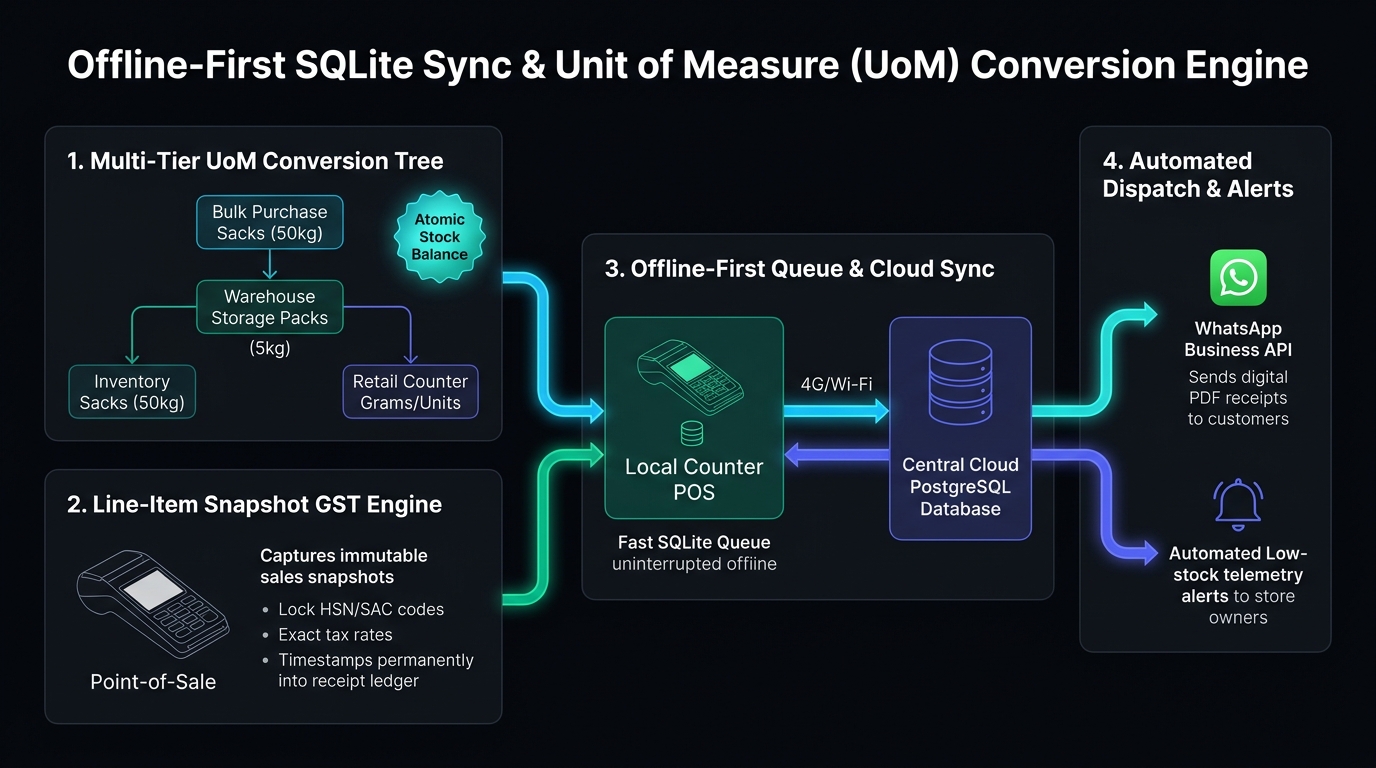
Commercial SaaS systems typically force a single static unit per SKU. Every conversion requires manual staff estimates and ad-hoc ledger adjustments that compound into massive inventory discrepancies by month-end.
The Multi-Tier Unit of Measure (UoM) Conversion Tree
| Product Category | Wholesale Inbound UoM | Godown Internal Storage UoM | Counter Retail Sale UoM | Real-Time Atomic Decrement |
|---|---|---|---|---|
| Grains & Pulses | 1 Wholesale Sack (50,000g) | 5 Warehouse Bags (10,000g each) | Loose Counter Scoops (500g / 1,000g) | Exactly 0.010 Sacks decremented per 500g checkout |
| Personal Care / FMCG | 1 Master Shipper (48 units) | 4 Shelf Inner Packs (12 units each) | Single Bar / 4-Pack Bundle | Atomic BOM deduction; zero stock count drift |
| Industrial / Hardware | 1 Factory Coil (100 Meters) | 5 Godown Spools (20 Meters each) | Cut-to-Length Meter Sales | Millimeter-precision inventory tracking |
In a bespoke system engineered by Cloud Ninja Dev, inventory conversion trees are built directly into the relational schema. When a 500g scoop is rung up, our database atomically decrements the parent batch quantity in a single ACID transaction.
Furthermore, custom reporting tools integrate cycle-count audits with mandatory reason codes (damage, transit leakage, supplier short-supply, sampling) and automated variance alerts. Data shows that AI-enabled inventory management improves stock accuracy by up to 35% — but intelligent forecasting is only possible when foundational UoM tracking is mathematically exact.
Architecting for India: Line-Item GST and Offline-First SQLite
Deploying a commercial retail application in India requires engineering for two non-negotiable operational realities: intricate GST compliance and unstable physical connectivity.
1. The Line-Item Snapshot GST Engine
Treating tax compliance as a superficial percentage calculation added at the bottom of an invoice guarantees severe accounting chaos. A custom billing engine enforces strict compliance standards:
- Line-Item Tax Snapshots: Tax rates, HSN/SAC codes, and cess values are frozen directly onto each individual invoice line item at the exact microsecond of checkout. If government authorities revise a GST slab next quarter, historical accounting ledgers and audited tax filings remain completely uncorrupted.
- Place-of-Supply Routing: The system automatically determines intra-state (CGST + SGST) versus inter-state (IGST) breakdowns based on the customer's verified GSTIN state code.
- Tax-Inclusive vs. Exclusive Splitting: Seamlessly toggles between printed MRP retail counter sales (where tax is extracted backwards) and B2B wholesale invoices (where tax is added onto base cost).
Indian Tax Engine: Custom Architecture vs. SaaS Surface Tags
| Compliance Parameter | Generic SaaS Billing Tool | Custom Line-Item GST Engine (Cloud Ninja Dev) |
|---|---|---|
| Tax Rate Storage | Live dynamic lookup (slab changes corrupt past years) | Immutable line-item snapshot locked at moment of sale |
| HSN / SAC Code Logic | Basic text label on invoice template | Relational HSN mapping tied to inventory master data |
| Composite & Mixed Supply | Manual calculation required for bundle taxes | Automated tax apportionment across bundled items |
| Credit Notes & Debit Notes | Disconnected from core stock ledgers | Automated reverse-tax entries with atomic inventory return |
2. Offline-First SQLite Architecture
While cloud computing represents over 65.51% of global inventory software revenue, an Indian godown enclosed by thick concrete walls or a basement retail counter frequently experiences network dropouts.
In our cross-platform mobile app development and desktop architectures, we deploy an offline-first local database design:
- Every counter transaction writes instantly to a local, encrypted SQLite database.
- The counter prints invoices, scans barcodes, and issues change in under 3 seconds with zero internet connection required.
- When 4G or fiber Wi-Fi connectivity recovers, an event-driven synchronization worker transmits batched transactions to the central cloud PostgreSQL database using deterministic conflict resolution rules (append-only ledger for transactions; last-write-wins for master catalog updates).
5 Critical Questions to Vet Any Retail Billing Solution
Before signing a long-term agreement with any retail software vendor, demand clear technical answers to these five criteria:
- Does the software continue processing barcode checkouts when the internet connection completely drops? If the counter freezes during a network outage, walk away.
- How does the system handle multi-tier Unit of Measure conversions from bulk sacks to loose retail units? Ensure the database maintains atomic fractional decrements without requiring manual spreadsheet adjustments.
- Are GST tax rates and HSN codes saved immutably on each invoice line item? Verify that future government tax changes will never alter historical audit records.
- Do I own 100% of the private source code, deployment blueprints, and customer databases? Avoid platforms that charge "data extraction penalties" if you decide to migrate.
- Can the billing system automatically dispatch digital GST invoices via the official WhatsApp Cloud API? Eliminate paper thermal receipt expenses while capturing verified customer contact records (explore our guide on why custom WhatsApp appointment automation beats generic SaaS).
Frequently Asked Questions (FAQ)
What causes phantom inventory in Indian retail billing software?
Phantom inventory occurs when software records do not match physical shelf quantities. In Indian retail, this is primarily caused by rigid single-unit data schemas that cannot handle multi-tier Unit of Measure (UoM) conversions (e.g., buying in 50kg bulk sacks and selling in 500g loose scoops). Without atomic conversion trees, manual conversions create compounding calculation errors that corrupt closing stock counts.
How does an offline-first architecture ensure counter billing never stops?
An offline-first application writes every transaction locally to an embedded, high-speed SQLite database on the counter tablet or PC. The system scans barcodes, calculates GST, and prints thermal receipts in milliseconds without waiting for cloud round-trips. When internet connectivity is restored, an automated queue synchronizes all transactions to the central cloud PostgreSQL database without cashier intervention.
Why should GST tax calculations be stored as line-item snapshots rather than dynamic lookups?
If a billing system dynamically calculates tax by looking up a product's current tax slab, any future government tax revision (e.g., moving an item from 12% to 18% GST) will retroactively alter the reported tax figures on historical invoices. Storing tax rates and HSN codes as immutable line-item snapshots ensures accounting ledgers remain permanently audit-compliant.
How does code ownership protect a retail founder from compounding software license costs?
With commercial SaaS, adding checkout counters, warehouse staff accounts, or new retail branches triggers mandatory monthly subscription increases. With 100% code ownership, the software is your proprietary business asset running on standard raw cloud infrastructure, allowing you to add unlimited registers and users with zero additional licensing fees.
How quickly can Cloud Ninja Dev deliver a custom billing and stock management app?
Through our disciplined 14-day delivery sprint, we map your SKU catalog, configure multi-tier UoM trees, implement line-item GST calculations, integrate barcode scanners, and deploy an offline-ready billing application live on your counter in two weeks flat.
Launch Your Custom Billing & Stock MVP in 14 Days with Cloud Ninja Dev
You don't need a six-month IT overhaul to gain control over your checkout counter and warehouse inventory. You need a focused sprint engineered around the specific operational realities of your shop.
At Cloud Ninja Dev, we engineer custom billing and stock management applications with 100% code ownership, sub-second performance, offline-first reliability, and seamless GST compliance in a focused 14-day production sprint:
The 14-Day Custom Billing Sprint Engineering Roadmap
| Sprint Phase | Timeline | Core Engineering Deliverables | Retailer Milestone |
|---|---|---|---|
| Phase 1: Catalog & Schema Design | Days 1 – 3 | Product taxonomy, UoM conversion trees, GST/HSN mapping, pricing rules | Finalized database schema blueprint |
| Phase 2: Barcode Flow & Counter POS | Days 4 – 5 | USB/Bluetooth scanner integration, offline SQLite write engine, <5s cart flow | Working counter checkout prototype |
| Phase 3: GST Engine & WhatsApp Cloud API | Days 6 – 8 | Line-item tax engine, digital PDF invoice generation, WhatsApp receipt dispatch | End-to-end transaction testing |
| Phase 4: Reconciliation & Cloud Handover | Days 9 – 14 | Stock variance audit tools, cloud sync worker, 100% Git repository transfer | Live counter deployment with zero SaaS rent |
Stop paying software rent on a system that limits your retail growth.