
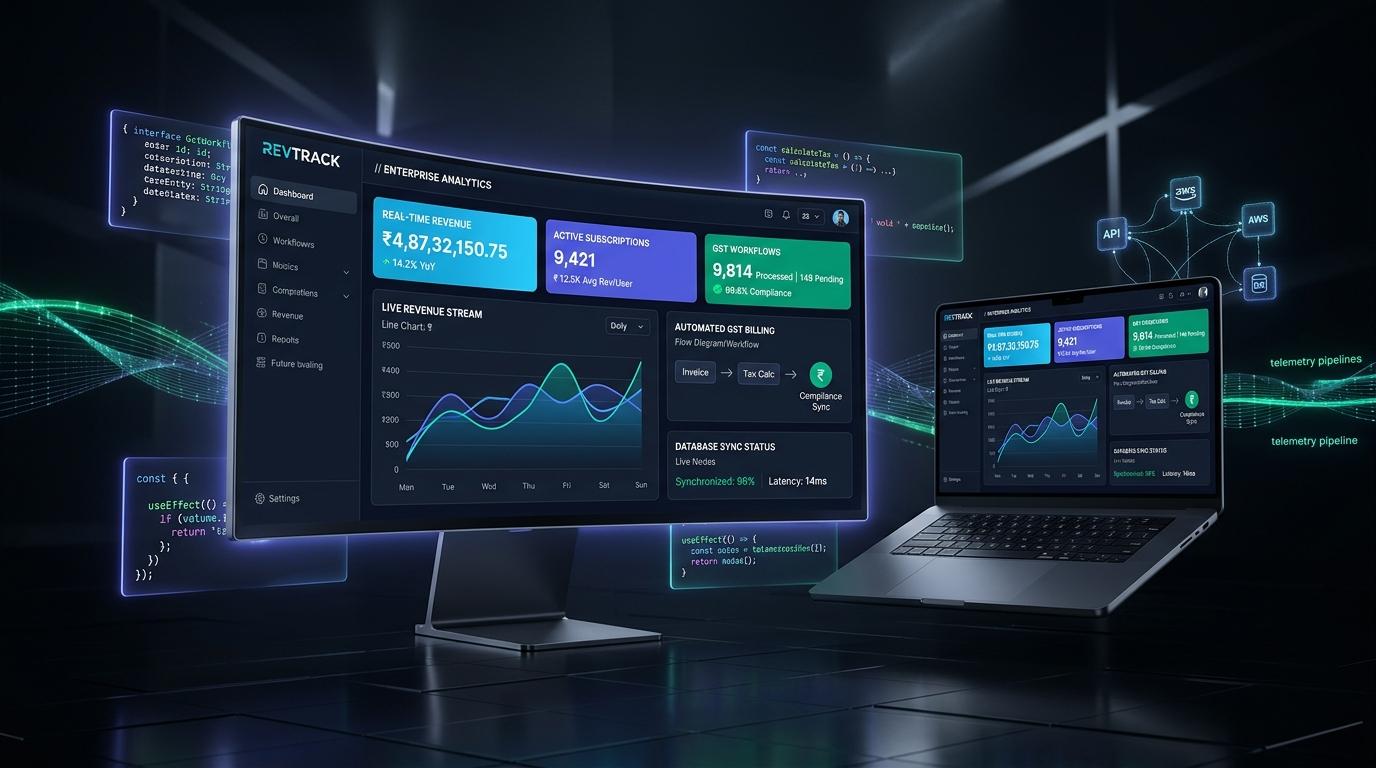
Discover why Indian small businesses are choosing bespoke custom web application development in 2026 to streamline complex operations, eliminate software rent, and transcend the rigid boundaries of off-the-shelf SaaS.
The Strategic Shift to Custom Web Applications in 2026
A standard SaaS subscription works adequately until your billing cycle clashes with your shop's invoicing realities, or the inventory module refuses to accommodate the custom multi-tier tax slab your supply chain depends upon. That is the inevitable glass ceiling of rented software: it is architected to satisfy the generic common denominator, never your business's proprietary competitive edge.
Across India, ambitious merchants, wholesale distributors, and emerging D2C brands are hitting this ceiling earlier than ever. The decisive response in 2026 is an accelerating pivot from renting generic software to engineering and owning proprietary digital assets.
Market data validates this profound transformation:
- The global custom software development market is projected to surge from $34.84 billion in 2023 to over $206.61 billion by 2032.
- Companies adopting bespoke software solutions experience an average 35% increase in operational efficiency and a 20% rise in revenue growth over three years.
- Rigorous architecture standards and clean engineering lead to 15% higher workforce productivity by eliminating manual workarounds.
Yet, many founders still confuse digital presence with operational capability: A brochure website merely displays your business to the public. A custom web application does the heavy lifting — orchestrating order routing, managing multi-tier inventory, automating vendor reconciliations, and syncing payments in real time. That operational power is the core case for bespoke web application development in 2026.
Custom Build vs. Off-the-Shelf SaaS: The Efficiency Gap
Generic software as a service (SaaS) wins on day one because of immediate sign-up, but loses decisively by month eighteen. The initial monthly fee seems economical, until your business process develops a localized nuance that the foreign SaaS platform cannot support.
| Operational Criteria | Off-the-Shelf Commercial SaaS | Bespoke Custom Web Application |
|---|---|---|
| Operational Alignment | Your staff must warp their physical workflow to fit the vendor's rigid UI | The application is engineered directly around your proprietary business process |
| Cost Structure | Compounding monthly subscription fees that escalate per employee seat and record | One-time 14-day build investment, followed by minimal predictable cloud hosting |
| Data Sovereignty | Encrypted in vendor-owned multi-tenant clouds; limited or paywalled CSV export | 100% direct database ownership (PostgreSQL / Supabase) with zero vendor lock-in |
| Custom Business Logic | Rigid dropdowns; unable to handle split GST, state cess, or custom trade credit | Endless flexibility: custom discounting engines, multi-warehouse sync, and ledger logic |
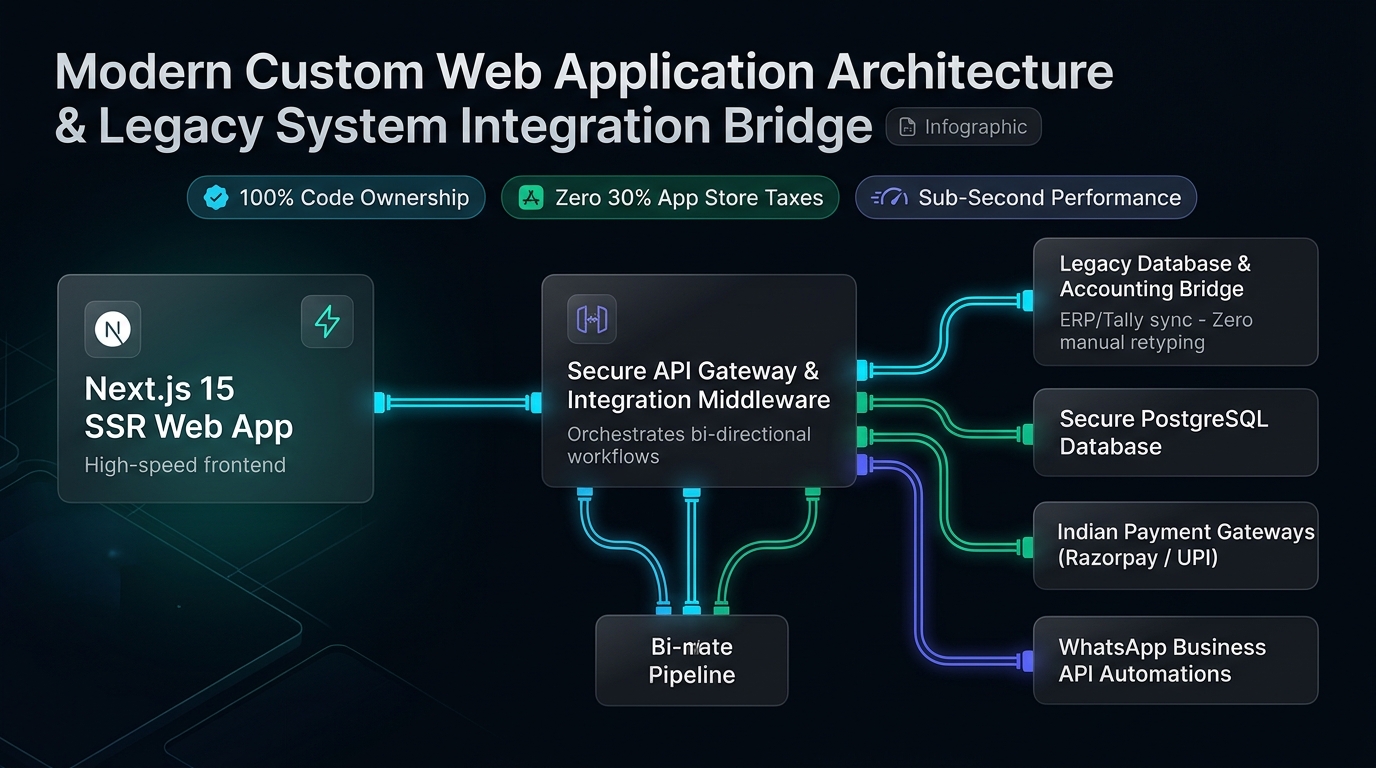
| Integration Capabilities | Locked behind pricey "Enterprise Tier" APIs and fragile Zapier connectors | Native API webhooks connecting directly to Indian payment gateways and WhatsApp |
| Performance & Speed | Bloated third-party trackers and sluggish international server latency | Sub-second Next.js 15 Server-Side Rendering (SSR) optimized for Indian 4G/5G networks |
Drag-and-drop low-code builders like Kissflow or Zoho Creator attempt to bridge this divide, but they merely push the ceiling slightly higher. The moment you require high-concurrency order processing, specialized cryptographic security for patient or client records, or automated bi-directional synchronization with WhatsApp Business, visual builders hit an unyielding wall.
The complexity ceiling is not an accidental flaw in commercial SaaS — it is their deliberate business model. Proprietary business workflows demand code engineered specifically for you.
Bypassing the 30% App Store Tax and Device Friction
When expanding digital operations, many founders assume their first step must be publishing an app on the Apple App Store and Google Play Store. While native mobile applications are indispensable for hardware-heavy use cases (explore our perspective on why custom mobile app development beats DIY builders), publishing native apps carries significant commercial friction:
- The 15%–30% App Store Commission: Apple and Google collect up to 30% on digital transactions, courses, and in-app service bookings.
- Review Delays and Gatekeeper Risk: Routine bug fixes and seasonal discount updates can be delayed for days inside opaque app review queues.
- Download Abandonment: Asking a first-time Indian buyer on a budget smartphone to download a 60MB APK before viewing a catalog results in massive funnel drop-off.
A custom Progressive Web Application (PWA) bypasses these barriers entirely:
- Zero App Store Taxes: Transactions flow directly through domestic Indian gateways like Razorpay, Cashfree, or PhonePe at standard payment processor rates (1.8%–2%), preserving your margins.
- Instant URL Accessibility: Customers access your portal immediately via a lightweight URL or QR code sent over WhatsApp, with no download required.
- Rich Native-Like Capabilities: Modern browsers provide full access to GPS location, camera scanning, web push notifications, and offline data persistence.
┌─────────────────────────────────────────────────────────────┐
│               CAPABILITY COMPARISON MATRIX                  │
├───────────────────────────────┬─────────────────────────────┤
│ Feature                       │ Web Application Status      │
├───────────────────────────────┼─────────────────────────────┤
│ GPS & Geolocation             │ ✅ Available via Web API    │
│ Camera & Barcode Scanning     │ ✅ Available via Web API    │
│ Instant Web Push Alerts       │ ✅ Full Modern Support      │
│ Offline Caching / Home Icon   │ ✅ Progressive Web App (PWA)│
│ Zero App Store Commission     │ ✅ 100% Revenue Retained    │
│ Deep OS Background Bluetooth  │ ⚠️ Reserved for Native Apps  │
└───────────────────────────────┴─────────────────────────────┘
Strategic Monetization Insight: Unless your primary value proposition requires continuous background Bluetooth peripheral communication, a high-speed custom web application delivers 100% of the operational functionality with zero app store commissions.
Bridging Modern Web Apps with Legacy Business Infrastructure
A major fear among established Indian merchants is fragmentation: Will building a modern web portal force us to abandon our existing accounting system or make staff type transactions twice?
Professional custom software engineering eliminates manual duplication through intelligent integration layers:
1. Direct REST & GraphQL API Bridges
Your custom web application interfaces directly with existing cloud databases, third-party logistics aggregators (Shiprocket, Delhivery), and CRM tools. An order placed on your web storefront instantly decrements your centralized warehouse database without human intervention (learn how this revolutionizes retail in our guide on why off-the-shelf inventory software fails Indian shops).
2. Intelligent Middleware for On-Premises Systems
Where legacy accounting packages (such as desktop Tally or older ERPs) lack modern real-time cloud webhooks, we deploy lightweight, secure synchronization middleware. The middleware reads transaction ledgers, queues updates securely, and reconciles records bidirectionally between your cloud web app and local accounting servers.
3. Standards-Compliant Architecture
By adopting strict API contracts and automated validation routines, your digital ecosystem remains stable and extensible for years. Furthermore, connecting your web portal to AI automation solutions and WhatsApp bots allows customers and field agents to interact with your backend using natural conversation.
Security, Compliance, and 100% Source Code Ownership
In enterprise software, ownership and security are inseparable. You cannot verify, harden, or audit code that you are legally prohibited from inspecting.
- 100% Source Code Ownership: At Cloud Ninja Dev, the entire Git repository, deployment blueprints, environment configurations, and database schemas are transferred directly to your organization upon project completion.
- Zero Vendor Lock-In: Because your application is built on modern, open-source enterprise technologies (Next.js, TypeScript, PostgreSQL), any qualified software engineer can maintain and extend your system without proprietary tool dependencies.
- Audited Security Architecture: Studies reveal that only 54% of major commercial code changes undergo rigorous security scrutiny. We engineer applications with strict role-based access control (RBAC), SQL injection prevention, cryptographic password hashing, and encrypted data-at-rest protocols.
Owning your codebase elevates your business from a vulnerable SaaS dependent to a digitally sovereign enterprise with verifiable intellectual property on its balance sheet.
5 Essential Questions to Ask Before Hiring a Web App Agency
Before signing an agreement with any software development agency, demand explicit written clarity on these five points:
- Will you transfer full Git repository ownership and cloud deployment access to my name? If the agency retains the code or charges an exit fee, walk away immediately.
- Is the web application built with Server-Side Rendering (SSR) for search engine indexing? Single-page apps (SPAs) built with bare React often render as blank shells to Google search bots. Ensure they build with Next.js for flawless technical SEO optimization.
- Do I collaborate directly with the senior engineer writing the code? Eliminating account managers and middlemen is what ensures rapid execution and technical accuracy.
- How do you handle Indian payment integration and automated GST compliance? Verify that invoice generators calculate intra-state (CGST + SGST) and inter-state (IGST) breakdowns automatically upon checkout.
- Can the platform scale into multi-location booking or internal workflow automation? Verify whether the architecture can accommodate advanced modules like custom appointment booking engines or custom business CRM automation.
Frequently Asked Questions (FAQ)
What is the difference between a business website and a custom web application?
A traditional business website is primarily informational—it displays contact info, service descriptions, and company credentials. A custom web application is an interactive software platform that executes business operations: authenticating users, managing complex relational databases, processing payments, generating automated GST invoices, and synchronizing workflows between employees and clients.
How do custom web apps help Indian businesses avoid the 30% app store tax?
Native applications distributed through the Apple App Store or Google Play Store are subject to mandatory 15%–30% commissions on in-app purchases and digital services. Custom Progressive Web Apps (PWAs) run directly in modern mobile browsers, allowing you to route payments through domestic gateways (Razorpay, Cashfree, UPI) where processing fees are standard (1.8%–2%), preserving full profit margins.
Can a new custom web app integrate with our existing accounting or ERP software?
Yes. Custom web applications connect to legacy accounting software (such as Tally, SAP, or desktop billing systems) via secure REST API bridges or automated synchronization middleware. This ensures that web transactions update your books automatically without requiring manual data re-entry.
Why does custom web software offer higher ROI than commercial SaaS subscriptions?
Commercial SaaS charges recurring fees per user and per record that compound as your business expands, while restricting customization and holding your data in proprietary formats. A custom web application requires an initial development investment, followed by minimal cloud hosting costs. It is tailored exactly to your operations, increases efficiency by up to 35%, and becomes a permanent, owned intellectual asset on your balance sheet.
How does Cloud Ninja Dev deliver a custom web application in just 14 days?
We replace agency bloat, slide decks, and non-technical account managers with a direct-to-engineer model. Utilizing modular Next.js architecture, pre-tested security components, and high-performance Tailwind design systems, we lock MVP requirements on Day 1 and ship production-ready web applications in two weeks flat.
Accelerate Your Digital Growth in 14 Days with Cloud Ninja Dev
The decision is not whether your business requires digital automation — your competitors are already deploying it. The real choice is whether you continue paying unending software rent for tools that limit your growth, or invest in an engineered custom web application that you own outright.
Cloud Ninja Dev builds production-grade web applications with 100% code ownership, sub-second performance, and seamless Indian payment and database integrations within a disciplined 14-day delivery sprint:
- Scope (Days 1–2): Direct consultation with our senior engineer to map your operational workflows and lock fixed-price deliverables.
- Build (Days 3–12): Agile full-stack engineering with continuous milestone visibility and real-world database testing.
- Handover (Days 13–14): Production cloud deployment, DNS configuration, and complete Git repository transfer to your company.
Ready to build a web application that scales your business?