
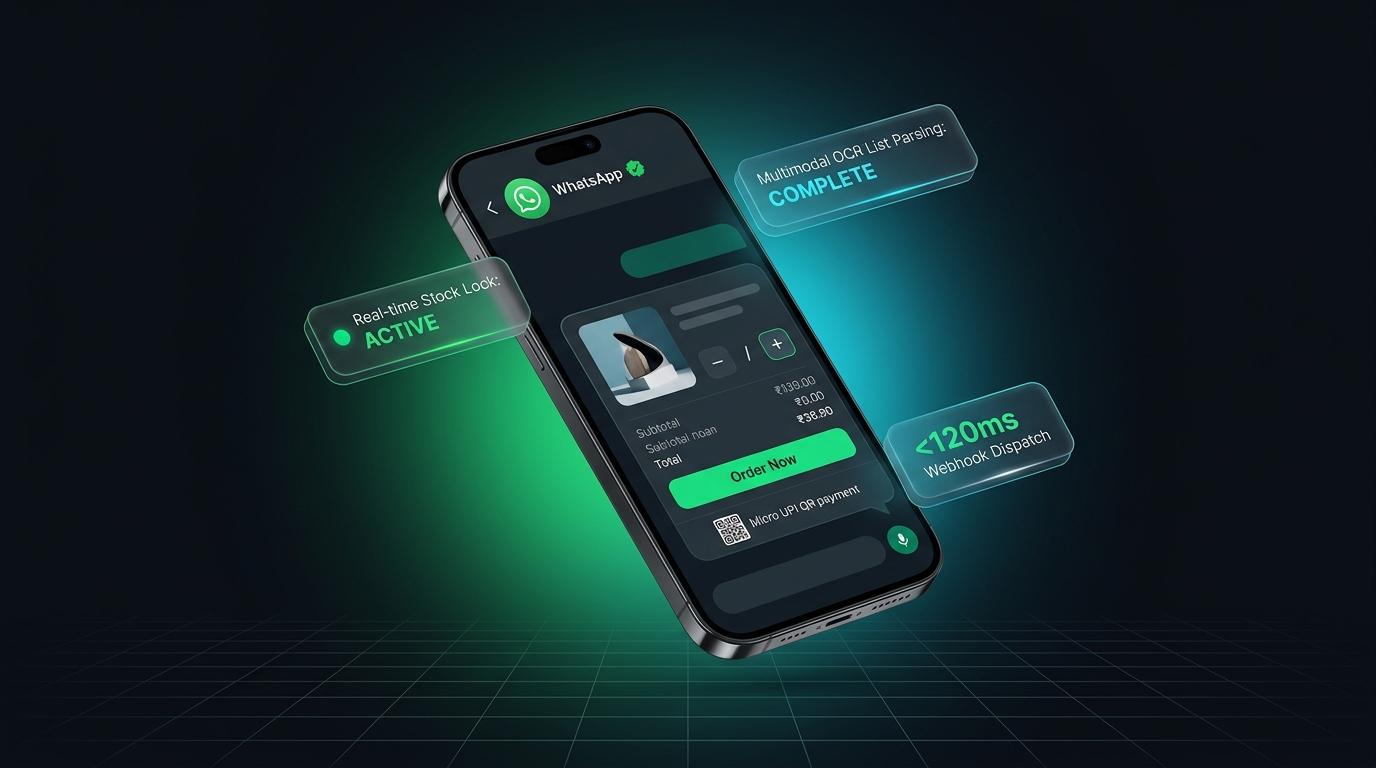
Stop manual order taking. Discover how to scale your business in 2026 with WhatsApp order automation, multimodal AI parsing, and seamless catalog ordering systems that you own outright.
The Manual Chat Trap: Why Your Shop's Growth is Stalling
Every unread WhatsApp message at 2 AM is a revenue decision your shop is making by default — and manual order taking means that decision is almost always wrong.
The reality most Indian shop owners face is a smartphone that never stops buzzing. A customer sends a voice note in Hindi or Tamil. Another sends a photo of a crumpled, handwritten grocery list. A third customer types out a list in four fragmented messages over twenty minutes. You — or an employee you pay every month — must read each message, cross-check shelf availability, manually calculate prices and GST, type out a confirmation, request payment, and then re-enter the entire order into an offline billing terminal or spreadsheet without making a costly clerical mistake.
That fragile chain of manual touchpoints is where local retail revenue leaks: items get missed, quantities get misread, stock gets double-sold, and frustrated buyers who do not get an immediate answer simply order from quick-commerce apps like Blinkit or Zepto.
WhatsApp is not a secondary marketing channel for Indian consumers — it is their primary digital operating system. 70% of Indian consumers prefer messaging local grocery stores and retail shops to place orders, proving that customer conversational volume is not an edge case; it is your core commercial pipeline. The upside of meeting buyers where they already spend their day is immense: businesses deploying conversational commerce on WhatsApp in India report conversion rates between 45% and 60%, compared to just 2% to 3% for traditional e-commerce websites.
That competitive gap does not close by hiring more staff to type furiously on shop phones; it closes by deploying intelligent AI automation solutions.
The case for WhatsApp order automation for shops begins in resolving the structural mismatch between a channel that converts exceptionally well and an overburdened manual counter that cannot keep up with order velocity.
From Photos to Cart: Automating the Indian Shopping List
In Western e-commerce, customers browse structured web categories, add items to a cart, and click checkout. In Indian retail, shopping behavior is deeply colloquial. A regular customer does not search a catalog of 4,000 SKUs; they take a ballpoint pen, write a 12-item list on a scrap of paper ("Ashirvaad Atta 5kg, Tata Namak 1 pkt, Maggi 4 pack, Amul Butter 500g, Surf Excel 1kg"), photograph it, and hit send on WhatsApp.
Off-the-shelf chatbot software fails completely here because generic rule-based bots demand strict numerical menu navigation ("Press 1 for Groceries, Press 2 for Dairy"). The customer gets frustrated and abandons the conversation.
A custom conversational engine built with modern multimodal AI transforms this chaotic interaction into a structured digital checkout:
- Multimodal OCR & Vision Parsing: When a customer sends a photo of a handwritten list, an ultra-fast webhook routes the image to a lightweight multimodal AI model (such as Gemini Vision OCR). The model deciphers irregular handwriting, recognizes common Indian brand colloquialisms, and outputs structured JSON line items.
- Audio & Voice Note Transcriptions: If a customer sends a 15-second voice note in Hindi, Marathi, or Hinglish, speech-to-text models parse spoken requests ("Bhaiya, do kilo basmati chawal aur ek packet chai patti bhej dena") directly into line items.
- Fuzzy SKU Matching & UOM Conversion: The backend compares the extracted text against the shop's PostgreSQL inventory table, normalizing loose weights ("250g adrak" into 0.25 kg increments) and packaging units.
- Instant Interactive Cart Summary: Within seconds, the customer receives an interactive WhatsApp message with native button controls: "We've prepared your order of 5 items. Total: ₹640. Would you like to confirm or make changes?"
By removing manual data entry at the ingestion point, the shop converts unstructured messages into confirmed sales before the buyer ever considers opening a competitor's app.
Operational Comparison: Manual Chats vs. Generic SaaS vs. Custom Automation
The table below illustrates the architectural differences between handling customer messages manually, leasing an off-the-shelf bot subscription, and owning a tailored conversational commerce system:
| Operational Feature | Manual WhatsApp Chats | Generic Chatbot SaaS (Monthly Fee) | Custom WhatsApp Order Engine (Cloud Ninja Dev) |
|---|---|---|---|
| Order Ingestion Format | Unstructured text, photos & voice notes manually transcribed | Rigid numeric button trees; breaks on photos or voice notes | Multimodal AI parsing for handwritten lists, audio, & freeform text |
| Inventory Verification | Manual physical shelf check; frequent phantom stock errors | Blind order logging; no real-time sync with shop POS | Live database stock lock; rejects out-of-stock items instantaneously |
| Payment Flow | Manual UPI QR screenshot sharing & visual bank reconciliation | Redirects users to external browser checkout links | In-chat dynamic UPI deep-links & auto-reconciling payment webhooks |
| Meta 24-Hour Compliance | Easily missed; manual templates require complex business manager setup | Generic utility triggers; vendor markup on official template rates | Meta Cloud API utility templates for automated dispatch & tracking |
| Recurring Cost Structure | High labor payroll; revenue lost to slow replies & dropped carts | Escalating per-conversation fees and restrictive monthly subscriptions | Zero software subscription markup; direct Meta API pass-through rates |
| Data & Code Ownership | Scattered chat histories stored on unbacked personal devices | Vendor lock-in; customer lists & transaction logs owned by SaaS | 100% intellectual property & database ownership on your infrastructure |
Mastering the 24-Hour Rule and Meta Compliance
Automated utility messages reduce failed orders by an average of 15% by keeping customers informed in real-time — but only if your system is built strictly within Meta's compliance framework.
The WhatsApp Business Cloud API enforces a strict 24-hour customer service window. Once a customer messages your shop, you have exactly 24 hours to communicate freely via conversational session messages. Once that 24-hour window expires, outbound messages cannot be sent unless you use a Meta-approved Message Template.
For a shop processing dozens of orders every day, this is an architectural constraint that dictates how order notifications must be engineered:
- Session Messages (Within 24 Hours): Free-form conversational messaging used while interacting with the customer, updating their cart, and finalizing payment.
- Utility Message Templates (Outside 24 Hours): Meta-approved operational notifications categorized specifically for order fulfillment, dispatch tracking, and delivery updates. These carry lower API fees and can be triggered programmatically whenever order status changes in your database.
According to global retail studies, 91% of online adults prefer receiving order status updates and shipping confirmations via direct messaging. When a customer places an evening order for next-day afternoon delivery, a custom-built backend automatically sends a compliant utility notification the moment the order is packed, sharing the live delivery partner tracking link without risking account suspension or messaging penalties.
End-to-End Conversational Commerce Architecture
Effective WhatsApp retail automation is not a cosmetic chat widget — it is a production-grade backend engine connecting messaging channels directly to your enterprise database, POS terminals, and fulfillment partners.
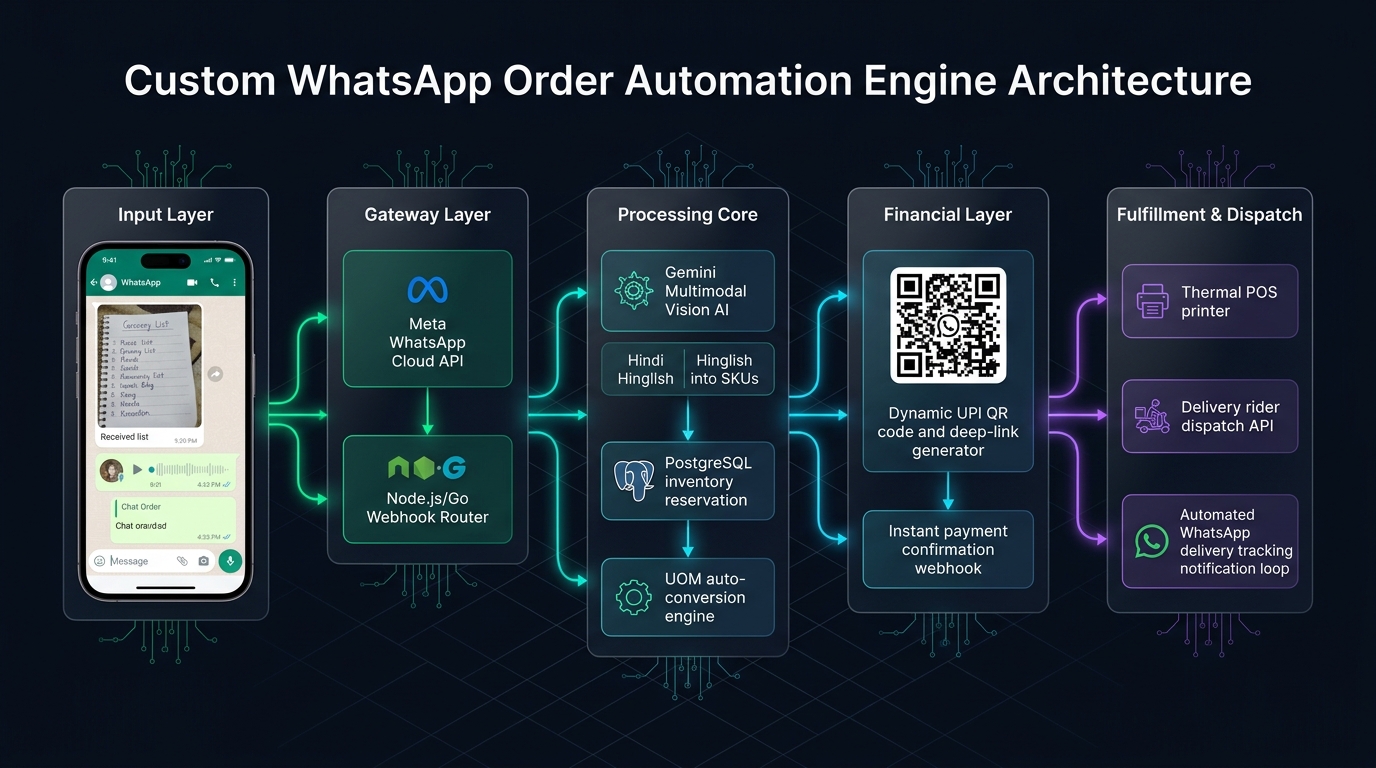
Key Architectural Layers:
- Ingestion & Webhook Layer: Meta's WhatsApp Cloud API broadcasts incoming customer payloads to an ultra-fast webhook router built on Node.js/Go. Webhooks are acknowledged within 200ms to guarantee zero dropped messages even during peak holiday rush hours.
- AI & Normalization Engine: Unstructured messages, voice notes, and camera photos of shopping lists are converted into structured JSON line items via multimodal parsing, resolving regional spelling variations and unit measurements.
- Central PostgreSQL Core & Stock Lock: To eliminate phantom stock, the order engine checks the central inventory table, reserves the requested items in an atomic database transaction, and decrements stock instantaneously. This matches the engineering principles outlined in our deep-dive on why custom billing and stock management apps beat generic SaaS.
- Dynamic UPI Payment Settlement: The engine generates dynamic UPI deep-links (supporting PhonePe, Google Pay, and Paytm) with encoded transaction references. The moment the customer authorizes the payment, a webhook from Razorpay or Cashfree triggers receipt generation.
- Fulfillment & POS Integration: The confirmed order instantly triggers an on-counter thermal POS printer via local network socket, alerts shop pickers, and dispatches an automated pickup request to local delivery partners (Dunzo, Porter, or your in-house delivery fleet).
Build vs. Buy: Why 100% Code Ownership is a Business Asset
When you rent your automation stack from a SaaS vendor, you are not just paying a subscription — you are paying for someone else's product roadmap, someone else's arbitrary message limits, and someone else's profit margins.
1. Eliminating the "SaaS Tax" on Retail Margins
Off-the-shelf WhatsApp marketing platforms charge heavy subscription fees layered on top of per-message markups. For a grocery, apparel, or hardware merchant operating on 8% to 15% net margins, paying ₹2,000 to ₹10,000 each month plus third-party bot conversation markups eats directly into net profits. As your business scales, the SaaS tax penalizes your success. In contrast, a custom solution built with custom software and automation connects directly to Meta's Cloud API, ensuring you pay only the rock-bottom wholesale API rates without intermediary cuts.
2. Overcoming Rigid Chatbot Boundaries
Pre-packaged tools are engineered for standard generic workflows. They cannot accommodate local Indian retail nuances: custom delivery radius fees, bulk wholesale pricing tiers, partial store-credit (khata) payments, or integration with legacy desktop inventory software. If an off-the-shelf tool doesn't support your warehouse workflow today, your only recourse is filing a support ticket that may sit unanswered for months.
3. Owning Your Core Infrastructure
When you commission custom software with Cloud Ninja Dev, you own the complete source code, deployment scripts, database schemas, and customer data. If your business expands from one location to a chain of five stores, your system scales alongside you without per-seat or per-store penalty fees. You maintain permanent operational leverage over your business technology.
Launch Your Custom WhatsApp Store in 14 Days
Moving from manual chat chaos to a fully automated WhatsApp storefront does not require months of enterprise software development. We follow an agile, direct-to-engineer delivery methodology designed to deploy battle-tested automation in two weeks.
| Sprint Days | Engineering Milestones & Deliverables | Operational Impact for Shop Owners |
|---|---|---|
| Days 1–3 | Meta Cloud API setup, WhatsApp Business verification, and webhook router infrastructure deployment | Official verified WhatsApp business account ready with zero message throttling |
| Days 4–7 | Multimodal OCR integration, inventory database sync, and conversational catalog flow engineering | Automatic parsing of handwritten lists and live stock reservation |
| Days 8–10 | Dynamic UPI payment integration (Razorpay/Cashfree/PhonePe) and thermal POS print daemon setup | Frictionless in-chat checkout with zero manual bank reconciliation |
| Days 11–12 | Meta utility message template submissions, automated dispatch alerts, and delivery webhook integration | 24-hour compliance unlocked with automated customer order status notifications |
| Days 13–14 | End-to-end load testing, staff onboarding, real-world edge case validation, and production cutover | Shop operational on full autopilot; manual typing and order entry eliminated |
Frequently Asked Questions
Can WhatsApp order automation handle handwritten shopping lists and regional languages?
Yes. By integrating lightweight multimodal AI models (such as Gemini Vision OCR) and Whisper-based audio transcription into your custom webhook pipeline, the system reliably extracts handwritten line items, handles Hinglish, Hindi, and regional terminology, and normalizes loose weights into exact inventory SKUs.
How does automated WhatsApp ordering prevent overselling during festival rushes?
When an order is parsed, the backend executes an atomic database transaction in PostgreSQL that locks and reserves the requested quantities immediately. If an item stock level drops to zero, the conversational bot informs the customer in real time and offers instant alternative recommendations through interactive reply buttons before payment is taken.
How does this comply with Meta's strict 24-hour customer messaging policy?
During an active order conversation, all messages operate within the free-form 24-hour service window. Once the order is confirmed and the window closes, all subsequent dispatch alerts, tracking URLs, and delivery confirmations are delivered via pre-approved Meta Utility Templates, ensuring 100% compliance without risking account bans.
What payment options can be embedded inside the WhatsApp order flow?
Customers can complete payments through dynamically generated UPI deep-links (launching Google Pay, PhonePe, or Paytm with pre-filled amounts), static on-screen UPI QR codes, Cash on Delivery (COD) confirmations, or revolving store credit balances (khata) for verified loyal customers.
How does custom WhatsApp automation compare to running a separate e-commerce mobile app?
While dedicated mobile apps require customers to spend mobile storage space, download updates, and remember passwords, WhatsApp is already installed on over 500 million Indian smartphones. Conversion rates on WhatsApp average 45%–60%, compared to 2%–3% on mobile websites, giving local retailers immediate customer adoption with zero onboarding friction. For businesses needing both, our mobile app development services and web development services provide unified, synchronized architectures.
Take Control of Your Retail Growth
Manual order taking caps your revenue at the number of hours you and your staff can spend typing on a smartphone. Off-the-shelf SaaS chatbots lock you into recurring subscription fees while breaking on real-world Indian retail habits.
A custom-built WhatsApp order automation engine gives your shop a 24/7 digital storefront that accepts handwritten lists, synchronizes inventory in real time, and collects instant UPI payments — all built on infrastructure you own 100%.
Explore our custom software and automation services and AI automation solutions to see real engineering case studies. Learn more about our transparent development process, or contact Cloud Ninja Dev today to schedule your technical WhatsApp Automation Audit.