
Navigate custom software development pricing in India for 2026. Learn why a direct-to-engineer strategy helps founders eliminate agency markups, secure 100% code ownership, and launch in 14 days.
The Reality of Software Pricing in India's 2026 Economy
Custom software development pricing in India no longer tells a simplistic "cheap outsourcing" story — and founders who treat it as one are the most likely to overpay.
India's technology ecosystem has matured into a global engineering powerhouse. Macroeconomic data highlights this transformation:
- IT services spending in India is forecast to grow 11.1% in 2026, according to Gartner forecasts exceeding $176 billion.
- India's overall enterprise technology spending is expanding by 13.4%, driven by massive domestic adoption of generative AI, automated cloud pipelines, and digital payment infrastructure.
This is not the profile of a discount labor market. It is a high-demand engineering landscape where senior full-stack talent commands genuine value — and where budgeting strategies built on decade-old assumptions quickly fail.
The "Lowest Bidder" Fallacy
Chasing rock-bottom hourly quotes ($10–$15/hr) on freelancing marketplaces remains the most expensive mistake an early-stage founder can make. Ultra-low rates almost universally conceal junior developers, fragmented communication, lack of architectural testing, and zero security hardening. What appears economical at the proposal stage inevitably mutates into costly technical debt, multi-month launch delays, and complete code rewrites within months of deployment.
In 2026, forward-thinking founders are bypassing traditional agency middlemen entirely. The most capital-efficient path runs directly to the senior engineer, collapsing coordination friction and investing capital straight into production code.
Hourly Rates & Project Complexity Tiers for 2026
When planning your software capital expenditure, the headline hourly rate is merely an initial metric — project scope, technical architecture, and integration depth determine where your total investment actually lands.
According to independent pricing audits by Clutch.co, most established software development firms in India charge between $25–$49 per hour. This rate band reflects a competitive global arbitrage: senior-level developers with deep expertise in Next.js, Python, PostgreSQL, and LLM orchestration deliver high-concurrency systems at rates that would barely secure junior support in the US or Western Europe.
2026 Project Complexity & Investment Matrix
| Project Tier | Scope & Capabilities | Typical Timeline | Expected Investment (India 2026) |
|---|---|---|---|
| Tier 1: High-Speed MVP Sprint | Core validation app, user authentication, UPI/Stripe payments, essential database schema | 14 Days (Sprint) | $2,500 – $6,000 (₹2L – ₹5L) |
| Tier 2: Production Web Application | Multi-role dashboards, automated GST invoicing, third-party logistics API bridges, sub-second SSR | 3 – 6 Weeks | $6,500 – $15,000 (₹5.5L – ₹12.5L) |
| Tier 3: Cross-Platform Mobile Suite | Native iOS & Android builds via React Native, offline data sync, push alerts, App Store approvals | 4 – 8 Weeks | $9,000 – $22,000 (₹7.5L – ₹18L) |
| Tier 4: Enterprise System with Custom AI | Proprietary RAG pipelines, autonomous WhatsApp agents, legacy ERP middleware, audit-grade security | 8 – 14 Weeks | $20,000 – $45,000+ (₹16.5L – ₹38L+) |
However, project tier benchmarks mean little if 50% of your capital is swallowed by non-technical agency personnel before a single commit is pushed.
Agency Bloat vs. Direct-to-Engineer: Where Your Budget Actually Goes
Traditional agencies are structured around heavy sales hierarchies. When you pay a traditional agency invoice, your capital is fractured across multiple non-coding tiers: sales commissions, regional account managers, dedicated project coordinators, and executive margins.
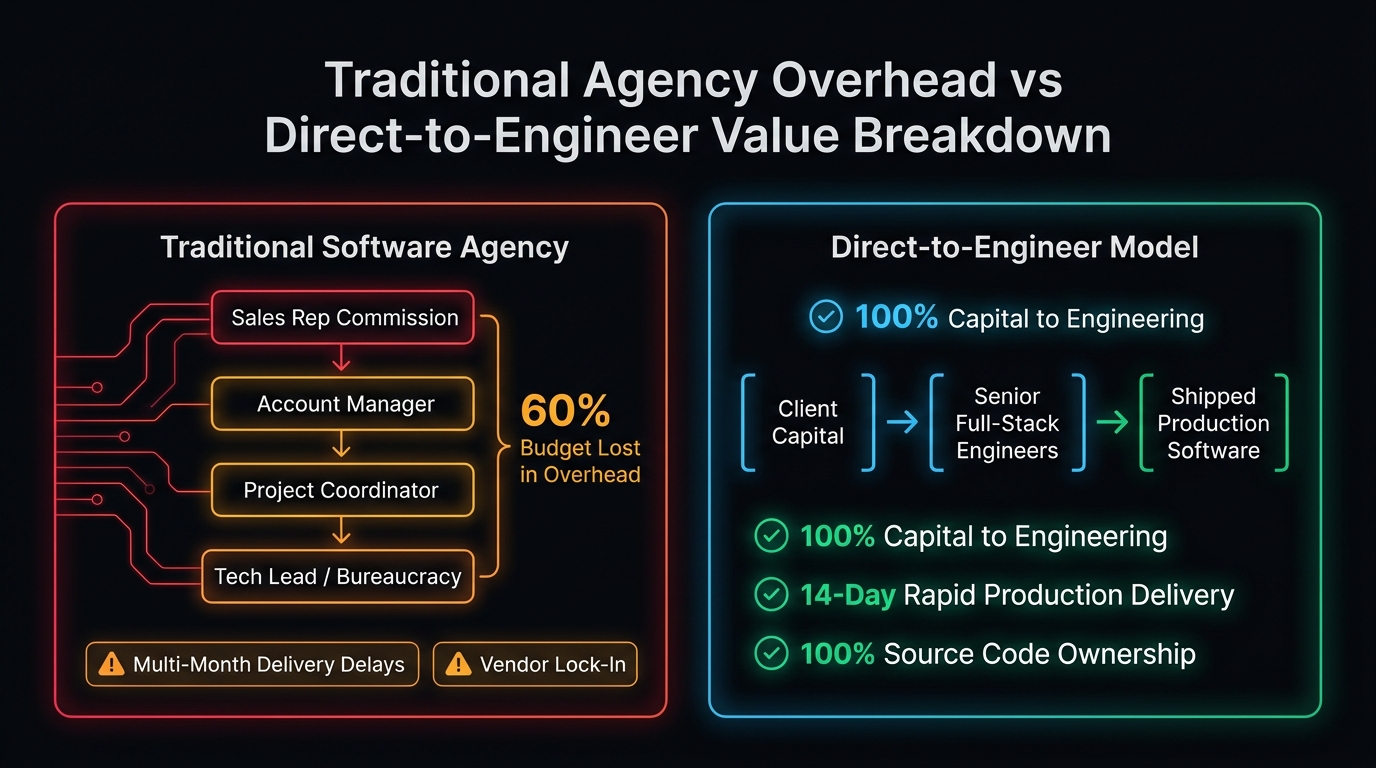
Capital Efficiency Breakdown: Traditional Agency vs. Cloud Ninja Dev
| Capital Allocation | Traditional Software Agency | Direct-to-Engineer Model (Cloud Ninja Dev) |
|---|---|---|
| Capital Invested in Senior Code | 35% – 45% (Junior devs execute under leads) | 100% directly allocated to Senior Full-Stack Engineering |
| Non-Coding Middlemen Overhead | 40% – 60% (Account Managers, Sales Reps, PMs) | 0% (Zero non-technical intermediaries) |
| Communication Pipeline | Client ➔ Sales ➔ PM ➔ Tech Lead ➔ Developer | Direct Founder-to-Engineer Collaboration |
| Delivery Methodology | Slow multi-month waterfall with change-order fees | Agile 14-day production sprints with fixed scope |
| Code & Architecture Ownership | Often withheld or gated behind "exit buyout" fees | 100% full source code & Git transfer on Day 1 |
| Post-Launch Flexibility | High monthly retainer minimums | Deploy on standard cloud infrastructure (AWS/Vercel) |
By adopting a Direct-to-Engineer model, you compress weeks of bureaucratic slide decks and ticket handoffs into instant technical alignment. When the founder speaks directly with the engineer writing the database queries, edge cases are solved in minutes rather than weeks.
The 2026 AI Premium: Agents, RAG Pipelines, and LLM Integration
The fastest-growing budget variable in 2026 is artificial intelligence integration. However, the market has split into two vastly different pricing realities: the agency hype premium vs. real-world engineering architecture.
Many traditional agencies charge a massive 200%–300% markup (quoting $25,000 to $50,000) for what is essentially a superficial OpenAI wrapper. In contrast, senior full-stack developers build bespoke AI automation solutions and LLM agents directly into your PostgreSQL architecture at transparent, predictable costs.
What Real-World AI Integration Actually Costs in 2026:
- Retrieval-Augmented Generation (RAG): Storing proprietary business manuals, product catalogs, and customer data in vector databases (e.g., PostgreSQL with
pgvector). Build investment: typically adds $1,500 – $3,500 to a sprint. - Autonomous Conversational Agents: 24/7 intelligent customer triage operating over official WhatsApp Cloud API or web chat (explore our breakdown of WhatsApp lead qualification automation). Build investment: $2,000 – $4,500.
- Monthly Inference Token Costs: Operating models via Google Gemini API, Groq (Llama 3), or OpenAI. For typical small-to-mid business volumes (10,000 monthly inquiries), raw token consumption averages just $15 – $60 per month when prompt caching and lightweight embedding models are properly configured.
Budget Pro-Tip: Insist on direct API key ownership. By holding your own accounts with Google Cloud, Groq, or OpenAI, you pay raw wholesale token rates directly with zero agency markup.
Hidden Infrastructure & Ongoing Operational Reserves
Any development estimate that stops at the launch date is incomplete. A production application requires a clear infrastructure and compliance reserve.
Recurring Operational Cost Reserve Guide
| Operational Component | Monthly Infrastructure Cost | Primary Cost Multipliers |
|---|---|---|
| Cloud Hosting & Serverless Compute | $20 – $80 / month | Vercel Pro, AWS ECS / Cloudflare Workers, traffic volume |
| Managed Relational Database | $25 – $120 / month | Supabase / AWS RDS PostgreSQL, automated daily backups, storage |
| Transactional Messaging & Webhooks | $15 – $70 / month | WhatsApp Business API utility rates, transactional email (Resend) |
| Annual OS & Security Maintenance | 15% – 25% of build cost / year | Annual Apple iOS & Android API upgrades, dependency security patching |
| Regulatory & Data Compliance | Variable by industry | Indian DPDP Act data residency, HIPAA / PCI-DSS compliance audits |
As detailed by industry cost analyses from SolTech, compliance and architectural security decisions made early determine whether maintenance costs remain modest or require massive retrofitting later. Building with custom software and backend automation ensures your database schema is compliant from the initial commit.
The 2026 Founder's Software Budget Checklist
Before signing any software development contract or paying an initial deposit, demand clear answers to these four criteria:
- Is the rate between $25–$49/hour or fixed-price sprint equivalent? Quotes below this floor usually signal offshore subcontracting or severe skill deficits.
- Will I communicate directly with the engineer writing my code? Eliminate layers of non-coding project managers that inflate costs and dilute requirements.
- Do I own 100% of the Git repository and deployment credentials on Day 1? Ensure you are building balance-sheet equity, not leasing software (read why custom web applications are the real growth engine).
- How are third-party APIs and cloud hosting billed? All infrastructure accounts (AWS, Vercel, Razorpay, Meta) must be registered in your company's legal name to avoid vendor lock-in.
Frequently Asked Questions (FAQ)
What is the realistic cost of custom software development in India in 2026?
Quality custom software development in India ranges between $25 and $49 per hour for senior full-stack talent. For fixed-scope projects, a production-ready MVP typically ranges from $2,500 to $6,000 (₹2L – ₹5L) delivered within a 14-day sprint, while multi-platform systems with custom workflows range from $8,000 to $20,000.
How does the direct-to-engineer model eliminate 40%–60% of traditional agency costs?
Traditional software agencies carry substantial overhead: sales commissions, client relationship managers, project coordinators, and commercial office leases. These administrative costs are factored into your billing. In a direct-to-engineer studio like Cloud Ninja Dev, you collaborate directly with senior developers who build your software, ensuring 100% of your capital is invested in production engineering.
How should startups budget for AI agents and LLM API integrations?
Instead of paying agency "AI hype markups", budget for the architectural build (typically adding $2,000 to $5,000 to the development phase) and direct wholesale API consumption. Modern LLM APIs (Google Gemini, Groq, OpenAI) are metered per token, typically costing an active business only $20 to $70 per month when prompt caching and efficient RAG pipelines are implemented.
What ongoing maintenance costs should businesses expect after launch?
Budget approximately 15% to 25% of your original build investment annually for ongoing operations. This covers cloud server hosting, automated database backups, third-party API transaction fees, annual iOS/Android OS compatibility updates, and security dependency patching.
How does Cloud Ninja Dev deliver production software within a 14-day sprint?
We eliminate bureaucratic waterfall phases. By utilizing modular Next.js and React Native architecture blocks, pre-tested database schema patterns, and direct founder-to-engineer communication, we lock MVP deliverables on Day 1 and ship production-ready applications in two weeks flat.
From Scoping to Production in 14 Days with Cloud Ninja Dev
The most expensive phase of any software initiative is the weeks lost circling decisions, waiting for agency slide decks, and negotiating with account executives who do not write code.
At Cloud Ninja Dev, we engineer custom full-stack web applications, mobile platforms, and business automations with 100% code ownership, sub-second performance, and transparent pricing in a disciplined 14-day delivery sprint:
The 14-Day Direct-to-Engineer Sprint Roadmap
| Sprint Phase | Timeline | Core Engineering Deliverables | Client Milestone |
|---|---|---|---|
| Phase 1: Direct Scoping & Schema | Days 1 – 3 | Business logic mapping, database modeling, fixed deliverables lock | Clear architectural blueprint & contract |
| Phase 2: High-Speed Full-Stack Build | Days 4 – 8 | Next.js / React Native core build, database write triggers, API gateways | Live working prototype on staging |
| Phase 3: Integrations & AI Workflows | Days 9 – 12 | Payment gateways (UPI/Stripe), WhatsApp webhooks, RAG vector sync | Complete end-to-end user testing |
| Phase 4: Cloud Deployment & Transfer | Days 13 – 14 | Production cloud launch, performance tuning, 100% Git repository transfer | Live software with zero agency lock-in |
Stop paying agency markups for software you will never truly own.