
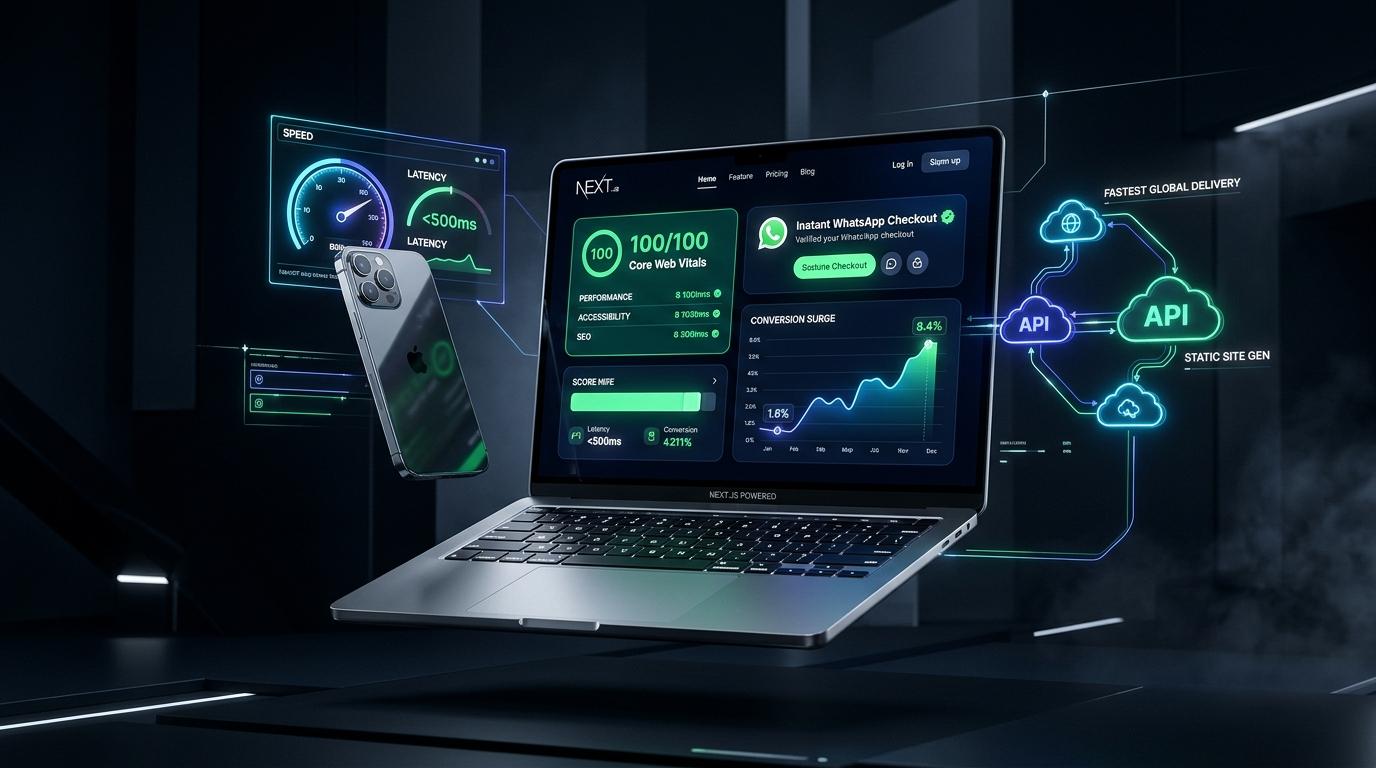
Is your landing page burning through marketing budgets without generating closed sales? Discover why drag-and-drop DIY templates bleed conversions on mobile devices, and how custom Next.js landing pages transform ad traffic into revenue in 2026.
The Real Definition of a High-Converting Landing Page
You are investing substantial capital into Google Ads, Meta campaigns, and influencer promotions. Clicks are registering on your analytics dashboards. Yet, virtually no one is filling out the form, initiating a checkout, or booking a consultation.
That painful leakage between ad spend and confirmed revenue is almost never a marketing failure — it is a landing page architecture failure.
Landing Page vs. Website Homepage: The Fundamental Distinction
- A Homepage Serves Everyone: It accommodates general browsers, returning account holders, job applicants, media inquiries, and investors. It features expansive navigation bars, multiple secondary links, and competing calls-to-action (CTAs).
- A High-Converting Landing Page Serves Exactly One Intent: It is an isolated, campaign-specific digital environment engineered around a single visitor persona, a single value proposition, and a single friction-free action. It ruthlessly eliminates all external navigation links that could distract the prospect from completing the goal.
According to independent usability benchmarks by the Nielsen Norman Group, a typical website conversion rate ranges modestly between 1% and 10%, with the median landing page conversion rate across commercial industries sitting at 6.6%.
However, moving from the bottom quartile (1%–2%) into high-performing territory (8%–14%) depends on two decisive engineering factors:
- Mobile Load Velocity: Extensive retail research proves that a tiny 0.1-second improvement in mobile page load speed increases retail conversion rates by 8.4%.
- Channel Friction: Replacing intimidating multi-field email forms with native WhatsApp conversational funnels elevates conversion rates to an astonishing 45% to 60%.
Why Subdomains Are the Professional Standard for High-Stakes Campaigns
When scaling acquisition campaigns, many founders make the mistake of bolting new promotion pages directly into their primary WordPress, Shopify, or Wix main theme. This forces the landing page to load the parent website’s bulky global CSS, heavy third-party tracking scripts, and rigid header templates.
Deploying dedicated campaign pages on subdomains (offers.yourbrand.com, promo.yourbrand.com, or launch.yourbrand.com) provides crucial architectural advantages:
- Independent Lightweight Codebase: The subdomain runs isolated, hand-optimized Next.js code with zero global theme bloat, achieving sub-second mobile rendering.
- Preserved Brand Trust: Prospects still see your primary verified domain name in their mobile browser address bar, ensuring zero drop in consumer confidence.
- Risk Isolation & Blast Radius Protection: High-velocity marketing experiments or A/B testing scripts run on the subdomain without any risk of slowing down or breaking your core e-commerce catalog or internal portal.
- Zero Navigation Clutter: Ephemeral promotional pages do not contaminate your permanent site architecture or disrupt your advanced technical SEO hierarchy.
Architectural Naming Rule: Name campaign subdomains by ongoing commercial function (
get.yourbrand.comoroffers.yourbrand.com), rather than temporary holidays (diwali2025.yourbrand.com). Functional subdomains can be continuously reused, preserving accumulated domain authority.
The Hidden Cost of DIY Drag-and-Drop Builders
Visual drag-and-drop landing page builders (Elementor, Wix, Squarespace, Unbounce) feel deceptively easy during desktop design sessions. The catastrophe manifests when an actual buyer clicks your ad on a mid-tier Android smartphone over a crowded 4G/5G mobile connection.
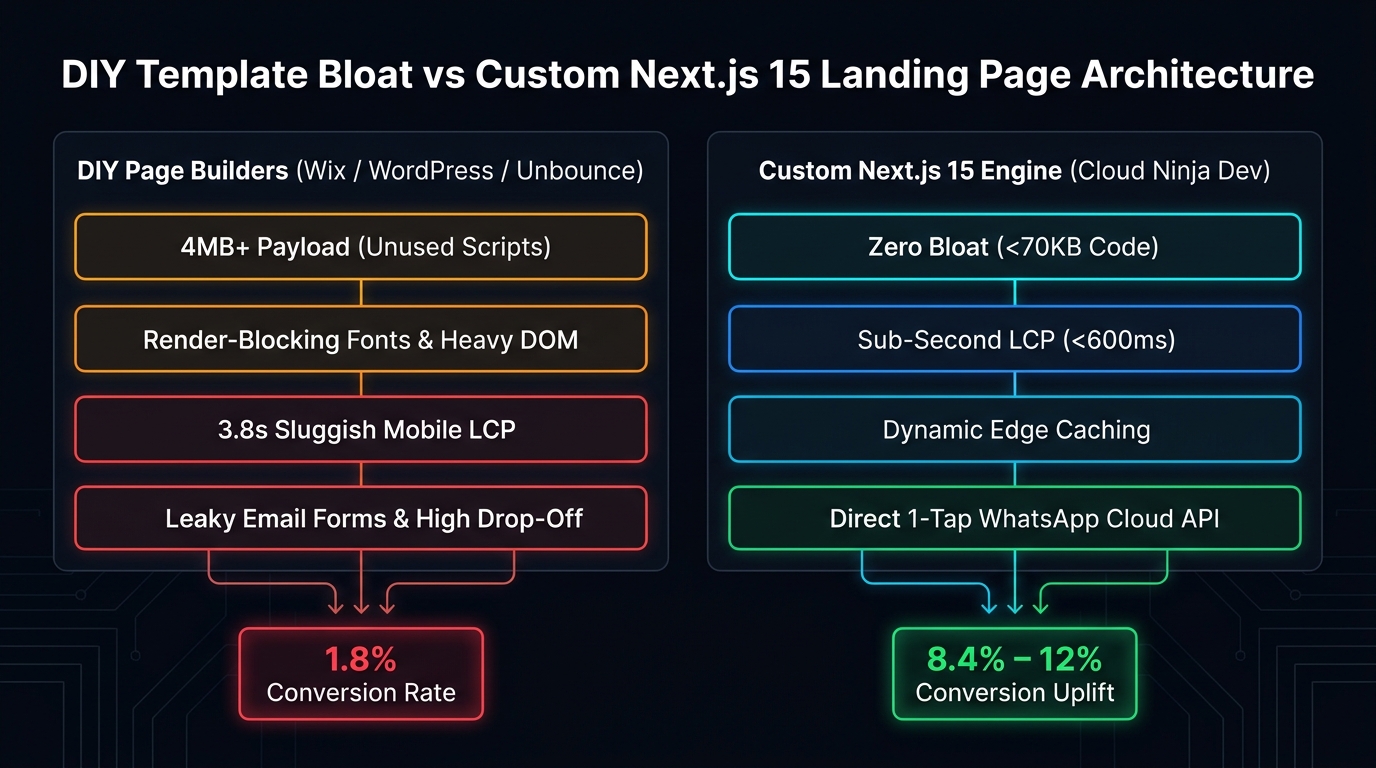
Because generic page builders must support millions of theoretical layouts, they bundle massive, unminified script packages, heavy font families, and redundant CSS rules onto every single page load.
Mobile Latency vs. Conversion Decay Matrix
| Mobile Page Load Time (LCP) | Realized Conversion Benchmark | Prospect Behavior on Mobile | Monthly Revenue Impact on ₹5L Ad Spend |
|---|---|---|---|
| Under 800ms (Sub-Second) | 9.5% – 14.0% Conversion | Instant immersion; zero drop-off | ₹47,500 – ₹70,000 in Revenue Captured |
| 1.5 to 2.5 Seconds | 5.8% – 7.2% Conversion | Noticeable rendering hesitation | ₹29,000 – ₹36,000 (Average baseline) |
| 3.5 to 4.5 Seconds | 2.1% – 3.4% Conversion | High bounce rate; tap back button | ₹10,500 – ₹17,000 (Severe margin loss) |
| Over 5.0 Seconds (DIY Bloat) | 0.8% – 1.4% Conversion | 70%+ of ad clicks bounce unrendered | ₹4,000 – ₹7,000 (Catastrophic ad waste) |
Every tenth of a second in mobile rendering delay directly erodes your return on ad spend (ROAS). Generic DIY templates squander dozens of tenths before a prospect even reads your headline.
Architecture Comparison: DIY SaaS Builders vs. Custom Next.js 15
| Technical Parameter | Generic Drag-and-Drop SaaS Builder | Custom Next.js 15 Landing Page (Cloud Ninja Dev) |
|---|---|---|
| Code Payload Weight | 2.5MB – 5.0MB+ (Unused libraries & trackers) | Under 70KB (Zero bloat; strictly hand-written code) |
| Core Web Vitals Performance | Poor (3.2s – 5.5s Largest Contentful Paint) | Sub-second LCP (<600ms); 100/100 Lighthouse score |
| Code & Layout Ownership | Leased subscription; vendor owns runtime | 100% full source code ownership in private Git repo |
| Monthly Software Overhead | $49 – $199 / month recurring builder fees | $0 / month builder fees (Hosted on raw cloud/Vercel) |
| Custom Business Logic | Rigid pre-built forms; cannot run live DB queries | Infinite flexibility: dynamic pricing, live stock sync |
| Portability & Exit Rights | Locked into vendor hosting; export impossible | Deployable anywhere (AWS, Vercel, Cloudflare Pages) |
With custom web application development, your landing page is engineered as a precision sales instrument. No extraneous widgets, no render-blocking external stylesheets, and zero vendor lock-in.
The WhatsApp Advantage: Slashing Lead Friction in 2026
Forcing modern mobile buyers in fast-moving commercial markets to type their full name, corporate email address, and paragraph-long project details into an HTML form introduces fatal friction. Email is no longer where rapid buying decisions occur.
Customers negotiate quotes, inspect product photos, confirm specifications, and transmit transaction receipts directly inside WhatsApp:
- Email Lead Forms: Suffer from 80%+ abandonment rates and delayed response times (explore our analysis on why delayed WhatsApp replies kill sales).
- Direct WhatsApp Integration: Achieves 45% to 60% conversion rates by turning an ad click into an immediate, authenticated conversation.
Lead Capture Mechanism: Static Form vs. WhatsApp Conversational Funnel
| Operational Attribute | Static Email Contact Form | Automated WhatsApp Tap-to-Chat Funnel |
|---|---|---|
| User Effort Required | Typing 5–7 fields on small mobile keyboards | Single 1-tap click opens native WhatsApp app |
| Lead Verification | High fake email rate (15%–25% junk data) | 100% authenticated phone number and profile |
| Initial Context | Generic message box | Pre-filled message text identifying exact campaign offer |
| Speed to First Contact | Hours to days (buried in receptionist inbox) | Sub-3-second automated conversational qualification |
| Lead Handoff | Manual CRM entry | Instant webhook sync to PostgreSQL / WhatsApp dashboard |
By integrating AI automation solutions and official WhatsApp bots, your custom landing page initiates an automated triage flow the moment the user taps the CTA, qualifying budget and intent before routing the lead to your senior sales team.
5 Critical Questions to Ask Before Commissioning a Landing Page
Before hiring an agency or developer to build your marketing pages, demand written answers to these five criteria:
- What is the guaranteed mobile Largest Contentful Paint (LCP) score on real 4G connections? If they cannot guarantee a sub-1.2s mobile render, your ad budget will be wasted.
- Will you build with Server-Side Rendering (SSR) or Static Site Generation (SSG)? Static Next.js generation guarantees instant global edge CDN distribution.
- Do I own 100% of the Git repository and design assets upon launch? Avoid agencies that trap your high-converting page inside proprietary subscription software (see why direct-to-engineer budget strategies succeed).
- How are leads captured and routed into our backend? Ensure the page features direct webhooks into your centralized database or CRM (learn how databases eliminate silos in why generic CRM fails small businesses).
- Does the page integrate official WhatsApp Cloud API click-to-chat triggers? Verify that inbound inquiries contain automated UTM attribution tags so you know exactly which ad variant generated the customer.
Frequently Asked Questions (FAQ)
What is the difference between a main website homepage and a dedicated landing page?
A website homepage serves multiple broad audiences (browsers, investors, existing clients, partners) and contains comprehensive navigation menus, multiple page links, and broad messaging. A dedicated landing page is engineered for a specific advertising campaign; it targets a single audience persona, presents one compelling offer, and removes all external links to focus the user exclusively on a single conversion action.
How much does a 0.1-second improvement in page speed affect conversion rates?
Independent research across millions of commercial mobile sessions confirms that every 0.1-second reduction in page load latency yields an average 8.4% increase in conversion rates. On mobile devices, even a 1-second delay can cause conversion rates to plummet by more than 20% due to buyer bounce.
Why should marketing campaigns and seasonal offers be deployed on subdomains?
Deploying on a subdomain (e.g., offers.yourbrand.com) isolates the campaign page from the bulky global code, plugins, and headers of your main website. This allows your developer to write lightweight, ultra-fast custom code that loads in under 600ms, while preserving brand trust and protecting your primary site from experimental tracking scripts.
Why do WhatsApp tap-to-chat buttons outperform traditional contact forms in India?
Traditional contact forms create significant friction: typing on mobile keyboards, verifying email addresses, and waiting hours for an email reply. WhatsApp is already active on over 500 million smartphones in India. A tap-to-chat button opens an immediate conversation with pre-filled context, capturing verified telephone numbers and delivering up to 45%–60% conversion rates.
How quickly can Cloud Ninja Dev build and launch a custom, high-speed landing page?
Through our disciplined 14-day delivery sprint, we map your conversion offer, engineer custom mobile-first Next.js layouts, configure WhatsApp Cloud API webhooks, conduct rigorous cross-device speed testing, and deploy to your custom subdomain in two weeks flat.
Launch Your Custom Sales Engine in 14 Days with Cloud Ninja Dev
Your landing page is not an artistic decoration — it is the front-line sales engine of your commercial enterprise. It must be evaluated by the qualified revenue it captures, not how quickly a pre-made template was assembled.
At Cloud Ninja Dev, we engineer custom, high-converting landing pages with 100% code ownership, sub-second mobile performance, and seamless WhatsApp automation within a focused 14-day production sprint:
The 14-Day Landing Page Sprint Engineering Roadmap
| Sprint Phase | Timeline | Core Engineering Deliverables | Client Milestone |
|---|---|---|---|
| Phase 1: Offer & Conversion Architecture | Days 1 – 2 | Single-goal offer mapping, target buyer persona, copywriting wireframes | Approved narrative & conversion strategy |
| Phase 2: Mobile-First Visual Engineering | Days 3 – 5 | High-conversion UI, custom component design, responsive phone layouts | Visual sign-off on real mobile devices |
| Phase 3: Next.js Build & WhatsApp Webhooks | Days 6 – 10 | Hand-coded Next.js 15 engine, sub-second edge CDN setup, WhatsApp API | Working functional prototype on staging |
| Phase 4: Speed Hardening & Production Launch | Days 11 – 14 | 100/100 Core Web Vitals audit, subdomain DNS launch, 100% Git transfer | Live sales engine with zero builder rent |
Stop burning ad budgets on slow, generic templates.