
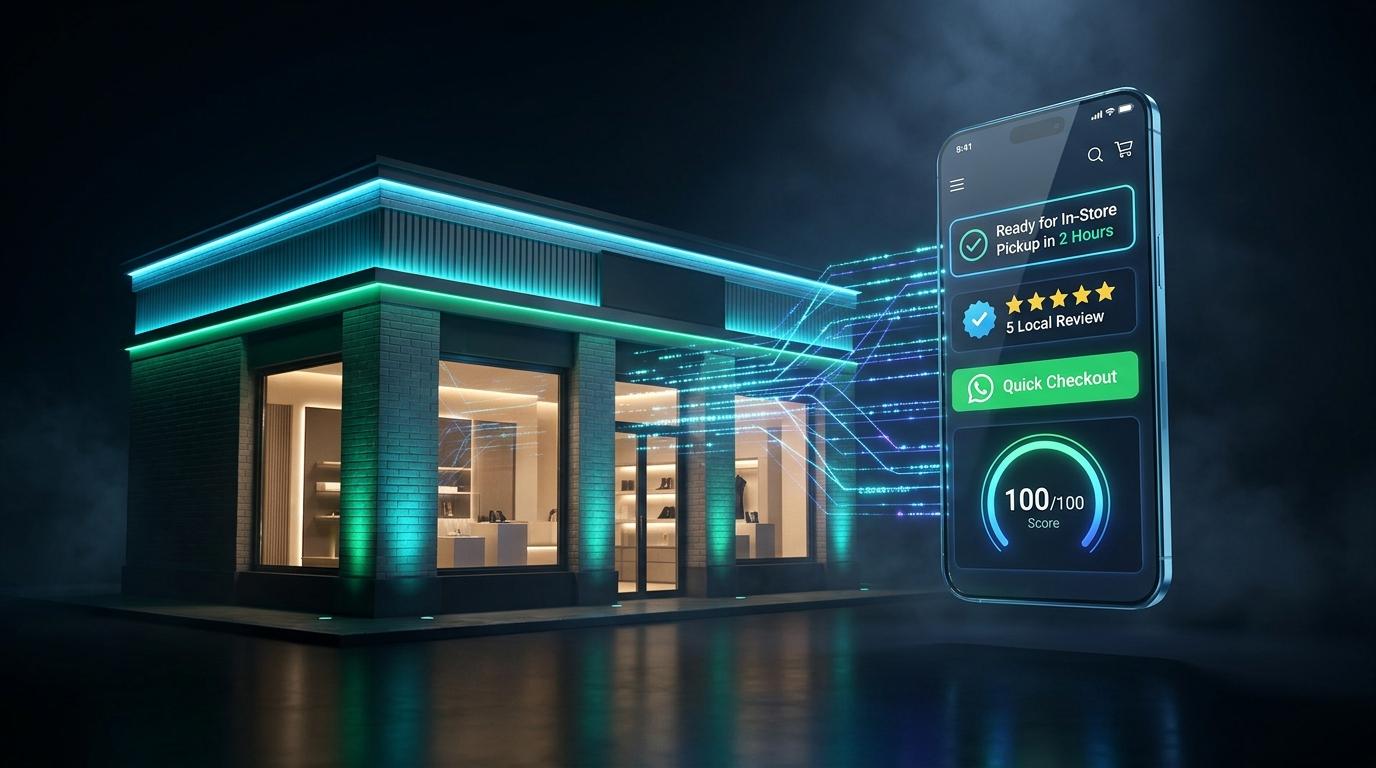
Is your physical storefront invisible to nearby customers searching on their smartphones? Discover why an engineered, custom mobile-first storefront outperforms DIY website builders in 2026.
The High Cost of Being Invisible to Local Searchers
A shopper standing two blocks from your doorstep is holding the only storefront window that matters today: their smartphone screen. If your business fails to appear prominently on that screen, the foot traffic and the transaction instantly go to whichever competitor does. That critical consumer decision unfolds in seconds — long before the buyer ever sees your physical signage, explores your aisles, or speaks with your staff.
Consumer intent leaves no room for hesitation:
- 62% of consumers will not patronize a business they cannot verify online, and over 98% of consumers actively use search engines to discover nearby local services and retailers.
- 76% of consumers who conduct a 'near me' mobile search for a local business visit a related physical store within 24 hours. That is commercial intent measured directly in foot traffic.
Relying exclusively on social media profiles (Instagram, Facebook pages) cannot bridge this gap. You do not own the platform layout, algorithms unpredictably throttle your organic reach, and social feeds cannot be indexed into Google's structured local search index.
A dedicated, owned web application development storefront is the only digital asset you fully control — and the only engine capable of turning high-intent "near me" mobile queries into ringing cash registers.
Why DIY Website Builders Fail the Local Shop Test
Drag-and-drop website builders (Wix, Squarespace, generic WordPress themes) promise rapid setups. However, their structural limitations become painfully obvious the moment you compete against regional chains and optimized competitors for Google's coveted Local 3-Pack.
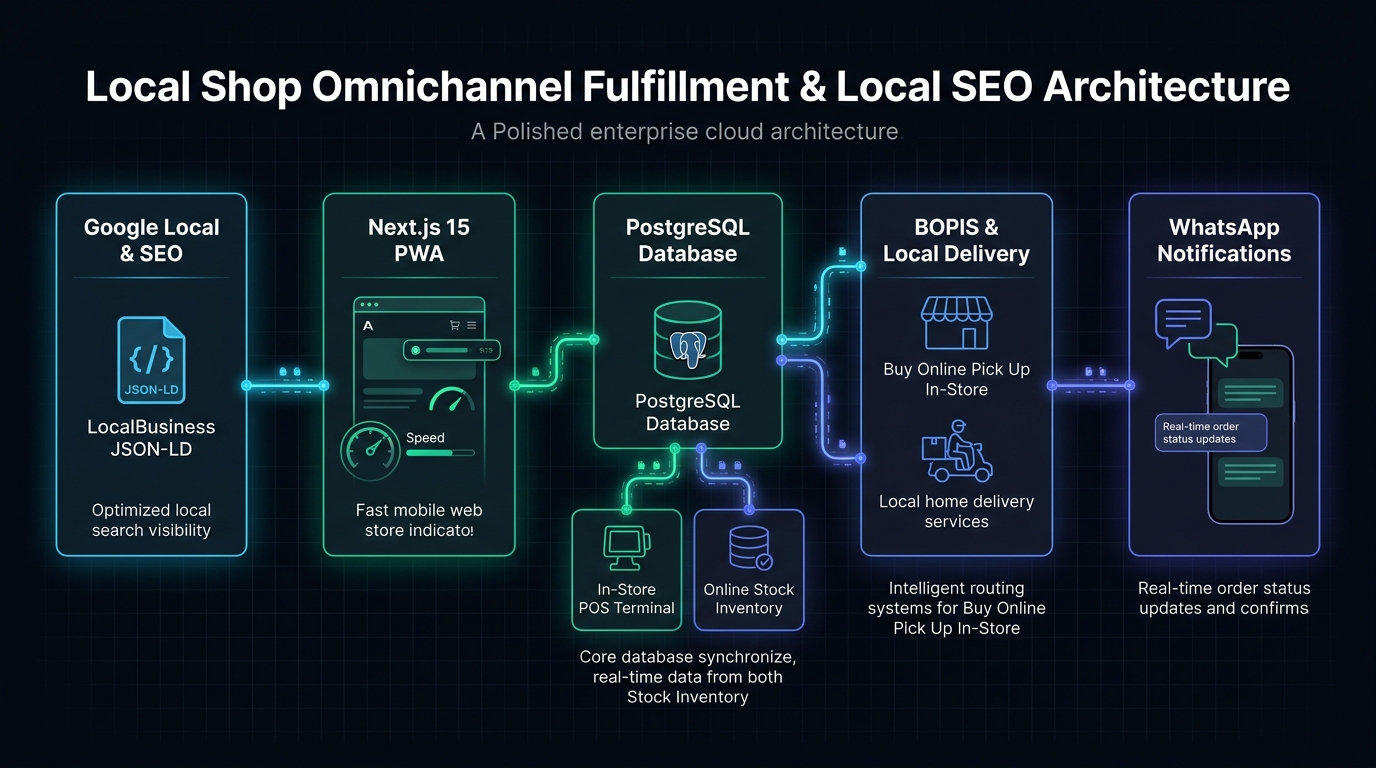
Generic DIY builders load excessive bloat: unminified JavaScript bundles, render-blocking CSS, oversized image files, and generic layout wrappers designed to accommodate millions of unrelated use cases. That overhead imposes a severe performance tax on mobile page loads.
Studies reveal startling benchmarks in local small business web infrastructure:
- 75% of small business websites load their primary content too slowly on mobile devices.
- Over 83% of local business websites completely lack validated Schema.org structured data.
These two flaws compound rapidly. A sluggish mobile site frustrates mobile shoppers on 4G networks, while missing schema data prevents search engine crawlers from parsing your operating hours, exact geo-coordinates, catalog availability, and service zones.
Performance & Architecture Comparison: DIY Builders vs. Custom Storefront
| Technical Capability | Drag-and-Drop DIY Builders | Custom Next.js 15 Storefront (Cloud Ninja Dev) |
|---|---|---|
| Mobile Core Web Vitals | Sluggish (3–6s LCP, heavy CLS layout shifts) | Sub-second LCP (<800ms), 100/100 Lighthouse score |
| LocalBusiness Schema | Minimal, generic tags or expensive plugin add-on | Deep JSON-LD Schema with live catalog & geo coordinates |
| Inventory Synchronization | Disconnected from physical POS; frequent stockouts | Real-time PostgreSQL sync across shelf and screen |
| Local Fulfillment (BOPIS) | Clunky shipping add-on; confusing pickup checkout | Native 1-click 'Ready for Pickup in 2 Hours' flow |
| Code Ownership | Rented subscription; locked into vendor's hosting | 100% full source code ownership transferred in Git |
| WhatsApp Automation | Third-party popup widget only | Native 2-way dispatch & pickup notifications via Cloud API |
Technical Local SEO Checklist: Dominating Nearby Search
Dominating local search results requires rigorous technical architecture rather than superficial keyword repetition. In our advanced technical SEO services, we engineer local storefronts to maximize local pack visibility:
Local Search Architecture Standards
| Architecture Pillar | Implementation Standard | Direct Search Engine Benefit |
|---|---|---|
| LocalBusiness Schema | Validated JSON-LD declaring address, geo, openingHoursSpecification, telephone, and priceRange | Gives Google crawlers machine-readable proof of physical proximity |
| Programmatic Location URLs | Discrete URLs for specific service regions (/indiranagar-bakery, /koramangala-delivery) | Captures hyper-local neighborhood queries without duplicate content penalties |
| Server-Side Rendering (SSR) | Pre-rendered HTML powered by Next.js 15 | Guarantees search spiders parse real catalog text rather than empty JS shells |
| Image Optimization | Automated WebP/AVIF compression with explicit aspect-ratio bounds | Eliminates Cumulative Layout Shift (CLS) and slashes mobile data consumption |
Mastering Local Fulfillment & Omnichannel Logistics
A local shop's website proves its return on investment when it begins moving physical inventory off the shelves. Local fulfillment is where an independent neighborhood retailer outmaneuvers giant national e-commerce aggregators: you are physically closer, faster to fulfill, and cheaper to reach.
Fulfillment Channel Matrix: Leveraging Local Proximity
| Fulfillment Method | Delivery Window | Operational Cost | Conversion Impact |
|---|---|---|---|
| Buy Online, Pick Up In-Store (BOPIS) | Ready in 1–2 Hours | Zero shipping cost | Highest conversion; drives in-store cross-sell |
| Hyper-Local Delivery (Radius / ZIP) | Same-Day (within 3–5 hours) | Flat local courier fee | Beats 2-day national shipping platforms |
| Standard National Courier | 2–5 Business Days | Standard weight-based rate | Fallback option for out-of-region buyers |
3 Core Fulfillment Rules for Local Retailers:
- Prioritize In-Store Pickup (BOPIS) at Checkout: Surface "Ready for Pickup in 2 Hours at [Your Street Address]" as the default first option at checkout. Shoppers who eliminate shipping wait times convert at significantly higher rates.
- Synchronize Inventory in Real Time: A single PostgreSQL database powering both your counter barcode scanner and your online store prevents the cardinal sin of local commerce: selling an item online that a walk-in customer purchased ten minutes earlier (learn more in our analysis on why generic inventory software fails local shops).
- Automate WhatsApp Order Updates: Automatically send order receipts, digital pickup QR codes, and Google Maps location pins directly to the customer's phone via official WhatsApp automation.
The Strategic Advantage: Speed, 100% Ownership, and Zero Lock-In
Data from the US Chamber of Commerce indicates that over 99% of small businesses utilize at least one technology platform. Technology adoption is no longer the competitive differentiator — what you actually own is.
Renting an e-commerce storefront from a proprietary website builder creates endless operational vulnerabilities:
- Compounding Monthly Subscriptions: Your monthly costs climb as you add products, staff accounts, and transaction add-ons.
- Platform Lock-In: If the vendor raises fees or discontinues critical plugins, you cannot export your custom design or database logic. You are forced to rebuild from scratch.
- 100% Code Ownership: At Cloud Ninja Dev, we transfer the entire Git repository, deployment scripts, database schema, and domain records directly to you. Your digital storefront is an appreciating asset on your business balance sheet.
Frequently Asked Questions (FAQ)
Why do DIY website builders fail to rank on Google's Local 3-Pack?
DIY website builders rely on heavy, bloated code frameworks that load excessive scripts and third-party trackers, leading to poor mobile Core Web Vitals. Crucially, most lack complete, validated LocalBusiness JSON-LD schema markup with exact geo-coordinates, operating schedules, and category hierarchies. Google's local algorithms prioritize lightning-fast, structured pages that resolve user queries instantly on mobile handsets.
What is BOPIS and how does it help local retailers compete against Amazon?
BOPIS stands for Buy Online, Pick Up In-Store. It allows nearby customers to browse your live inventory, pay online via UPI or card, and collect their merchandise within hours. Because local shops hold physical inventory close to the customer, they eliminate 24–48 hour shipping delays and shipping fees entirely. Furthermore, over 30% of shoppers who pick up items in-store make additional unplanned purchases at the counter.
How does LocalBusiness schema markup influence nearby mobile search traffic?
Schema markup is standardized machine-readable code embedded into your HTML. It explicitly informs Google's search crawlers about your business name, address, telephone number (NAP), geo-coordinates, service radius, customer review scores, and operating hours. When nearby shoppers search "best hardware shop near me" or "organic groceries open now", search engines present rich snippet cards directly from verified schema data.
Can a custom local storefront synchronize inventory with our physical shop register?
Yes. Our custom web applications connect directly to your centralized PostgreSQL or Supabase database. Whether an item is rung up on your physical barcode scanner at the counter or ordered via your mobile web storefront, stock counts update atomically in real time, preventing overselling and inventory leakage.
How quickly can Cloud Ninja Dev build and launch a custom local e-commerce storefront?
Through our disciplined 14-day production sprint, we map your inventory catalog, configure your local delivery radius and BOPIS workflows, implement validated Local SEO schemas, integrate domestic payment gateways, and launch your custom Next.js storefront in two weeks flat.
Launch Your Local Storefront in 14 Days with Cloud Ninja Dev
The primary obstacle preventing local shop owners from upgrading to custom software is the fear of drawn-out agency timelines. Three-month agency builds do not match the agility of a retailer running daily operations.
At Cloud Ninja Dev, we deliver production-ready, custom local e-commerce web applications within a focused 14-day delivery sprint:
The 14-Day Storefront Engineering Roadmap
| Sprint Phase | Timeline | Core Engineering Deliverables | Client Milestone |
|---|---|---|---|
| Phase 1: Discovery & Catalog Mapping | Days 1 – 3 | Local delivery zones, BOPIS pickup rules, SKU taxonomy, domain setup | Finalized architecture blueprint |
| Phase 2: High-Speed Next.js Storefront | Days 4 – 8 | Sub-second mobile UI, cart engine, PostgreSQL database modeling | Working prototype on test domain |
| Phase 3: Local SEO & Payment Gateways | Days 9 – 12 | LocalBusiness JSON-LD schema, Razorpay/UPI integration, WhatsApp webhooks | End-to-end transaction testing |
| Phase 4: Cloud Launch & Handover | Days 13 – 14 | Production cloud deployment, staff training, 100% Git repository transfer | Live storefront with zero recurring software rent |
Stop losing local foot traffic to slow, rented templates.