
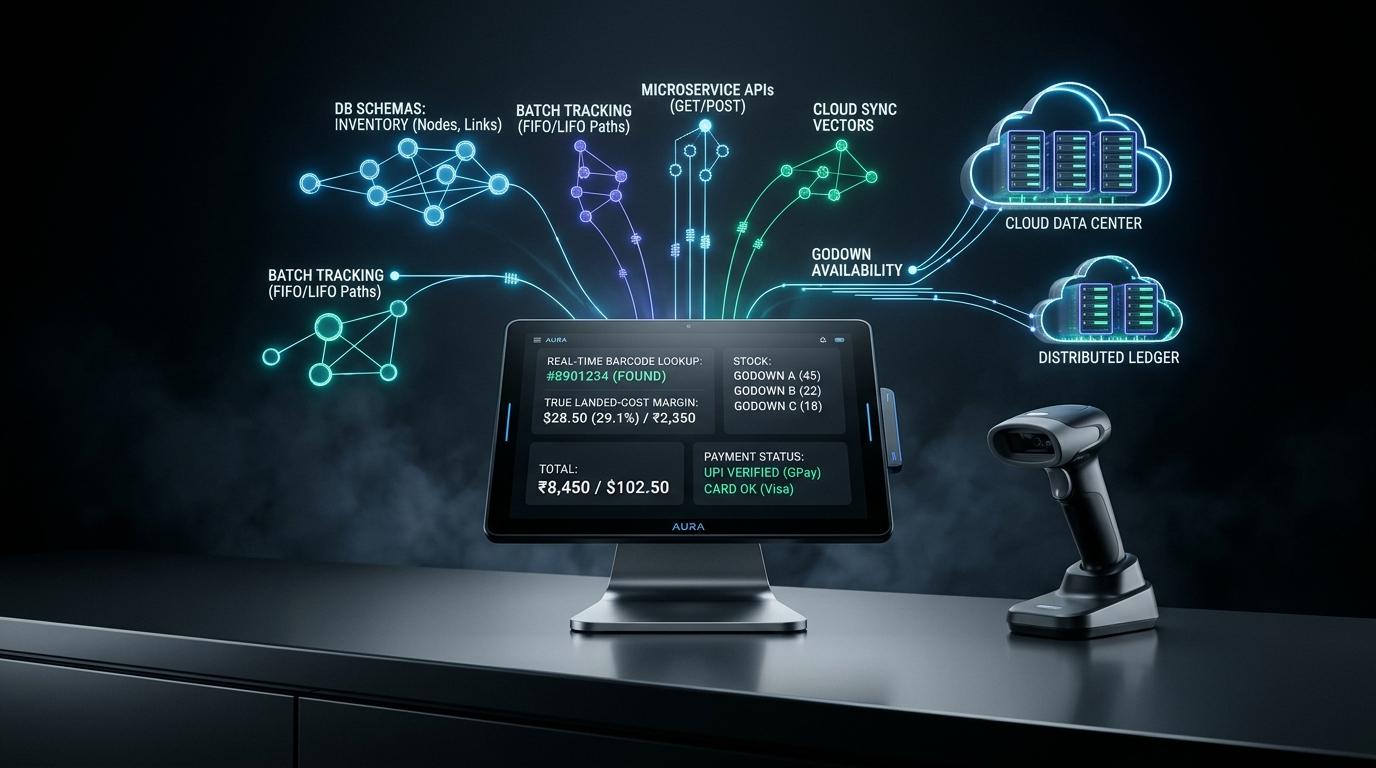
Stop losing hard-earned profit margins to rigid, closed POS software. Discover why commercial off-the-shelf systems fail growing retailers and how custom inventory solutions stabilize retail profitability in 2026.
The Hidden Cost of Generic Retail POS Software
Operational friction in retail rarely announces itself with a dramatic alarm. It erodes your margins quietly, transaction by transaction:
- A store manager spends two hours re-entering a distributor invoice into an Excel spreadsheet because the cloud POS only allows one supplier per SKU.
- A counter cashier manually overrides a sale price because the system failed to synchronize the newest batch cost.
- A godown supervisor discovers that an online customer ordered a product that was sold at the checkout counter thirty minutes prior.
By the time these small operational breakdowns are tallied at month-end, they have already permanently bled gross margin.
Most independent retailers begin their search for the best retail POS software by comparing headline monthly subscription rates ($49/mo or $99/mo). That advertised figure is almost never what you actually pay. Hidden surcharges in subscription SaaS — such as mandatory per-register fees, multi-location licensing, and gated reporting modules — routinely inflate retail software expenditures by 30% to 50% annually.
Off-the-shelf retail software is engineered with a fixed, rigid architecture and severe scalability constraints, leading to crippling operational bottlenecks during seasonal peak rushes.
Total Cost of Ownership: Commercial POS SaaS vs. Custom Build
| Cost Factor | Commercial POS SaaS (Lightspeed, Square, Shopify POS) | Custom Retail POS (Cloud Ninja Dev) |
|---|---|---|
| Base Monthly Software Rent | $89 – $299 / month per location | $0 / month (100% Owned Balance-Sheet Asset) |
| Additional Register & Staff Seats | $29 – $69 / month per additional register/user | Unlimited registers, godown tablets & staff users |
| Payment Gateway MDR Markup | Mandatory in-house processor penalty (+0.5%–1.0%) | Raw direct domestic rates via Razorpay / Stripe / UPI |
| Advanced Reporting & Batch Tracking | Paywalled under $300+/mo "Enterprise Tiers" | Native relational database analytics built-in |
| 3-Year Total Software Outlay | $12,000 – $28,000+ (Unrecoverable operational rent) | Fixed one-time sprint build + minimal raw hosting |
| Code & Data Ownership | Zero code ownership; vendor controls your data | 100% full source code & PostgreSQL database ownership |
Why High-SKU Retailers Need More Than a Generalist POS
A minimalist boutique managing 300 SKUs with a single domestic distributor can operate adequately on generic POS tools. However, high-volume retail sectors — grocery supermarkets, liquor stores, auto hardware, pharmacies, cosmetics, and electrical supply — manage thousands of active SKUs across dozens of distinct distributors.
Generalist cloud POS tools are engineered for the simple coffee shop or clothing rack. They crumble when confronted with high-SKU retail realities.
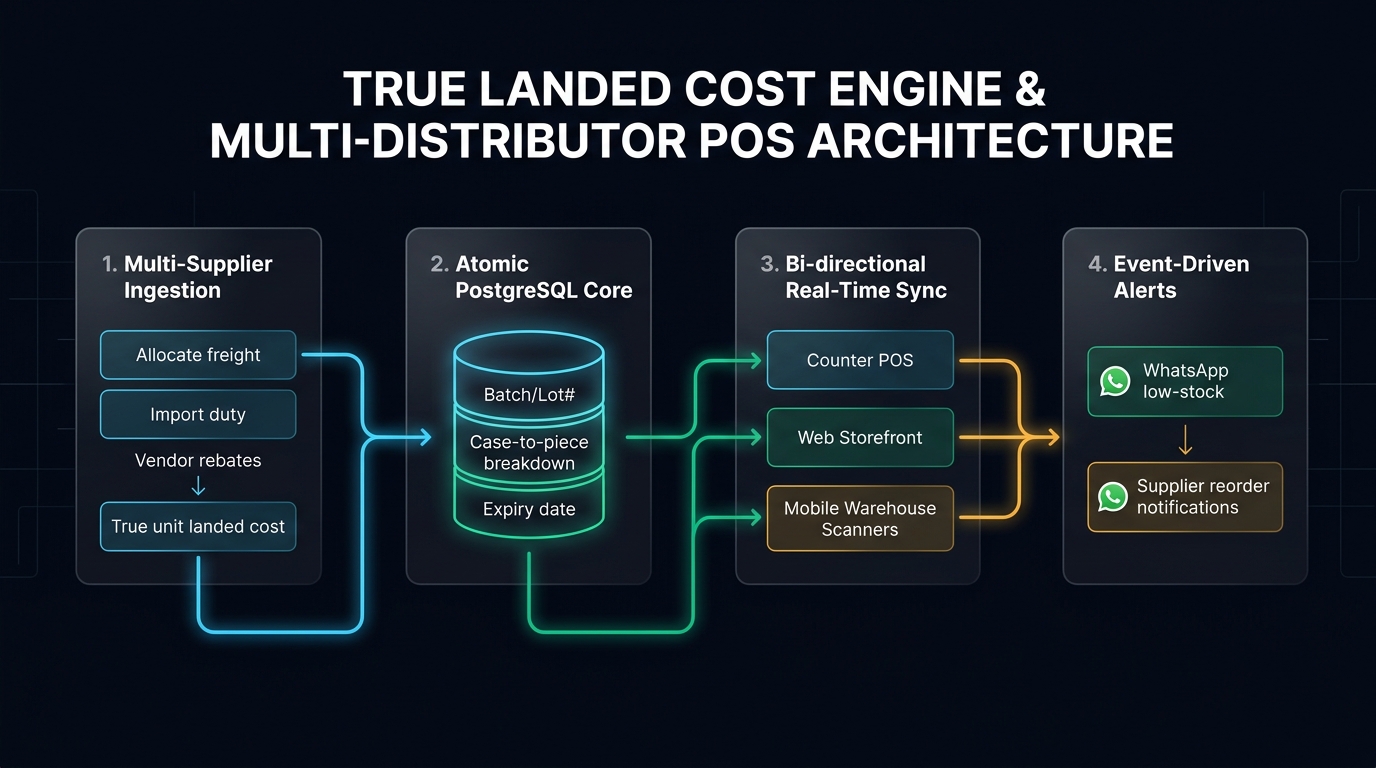
High-SKU Operational Demands vs. Generalist POS Limits
| Retail Requirement | Generalist Off-the-Shelf POS | Custom High-SKU POS Engine |
|---|---|---|
| Multi-Distributor Lineage | 1 vendor per item; destroys purchase history | Tracks multiple suppliers, pack sizes & credit terms per SKU |
| Batch, Lot & Expiry Tracking | Missing or gated behind enterprise tiers | First-In, First-Out (FIFO) batch routing with automated expiry alerts |
| Case-to-Piece Conversions | Manual deduction; causes stock count drift | Atomic relational database conversion (1 Case = 24 Pieces = 48 Halves) |
| Multi-Godown Split Stock | Sync delays of 5–15 minutes between stores | Sub-second atomic PostgreSQL locks across physical & web counters |
| Automated Reordering | Manual low-stock reorder lists | Automated WhatsApp purchase order dispatches directly to distributors |
Specialized retail architectures do not optimize for the generic common denominator. They start from the data schema up, ensuring that every barcode scan at the register atomically updates the central ledger without delay.
Protecting Profit Margins with True Landed Cost Calculations
Most standard retail POS platforms record only what you paid the supplier on the invoice. That figure is almost never what the merchandise actually cost to place on your shelf.
- Simple Unit Cost: The invoice purchase price divided by units received. It is easy to calculate, clean to record, and silently deceptive whenever freight, customs, insurance, or handling fees are involved.
- True Landed Cost: The base invoice price plus inbound freight, customs tariffs, transport insurance, warehouse handling, and volume rebates allocated proportionally across every unit in the shipment.
Financial Impact: The Landed Cost Margin Erosion
| Cost Element | Simple Unit Cost Model | True Landed Cost Allocation |
|---|---|---|
| Invoice Price per Unit | $25.00 | $25.00 |
| Inbound Freight & Drayage | Unallocated ($0) | +$3.20 per unit |
| Customs / Import Tariffs | Unallocated ($0) | +$1.80 per unit |
| Warehouse Offloading & Inspection | Unallocated ($0) | +$0.75 per unit |
| Effective Cost of Goods Sold (COGS) | $25.00 (Deceptive) | $30.75 (Actual) |
| Retail Shelf Price | $32.00 | $32.00 |
| Perceived Gross Margin | 28.0% ($7.00 profit) | — |
| Actual Realized Gross Margin | — | 3.9% ($1.25 real profit) |
Price your inventory from the simple invoice figure, and you have built an unintended, catastrophic discount into every customer transaction.
In a bespoke system built with custom software and backend automation, our database engine automatically calculates weighted average landed costs on every shipment receipt. It alerts management immediately if a supplier price increase or freight surcharge compresses gross margins below your target threshold.
Omnichannel Synchronization: Register POS Meets Web Storefront
Retailers competing in modern commercial markets must bridge physical store counters with digital storefronts. Market forecasts project that U.S. retail sales will reach up to $5.48 trillion, with omnichannel fulfillment accounting for the fastest-growing revenue segment.
When physical checkout registers run on one software platform while the e-commerce storefront runs on another, inventory data inevitably drifts. A customer orders a drill online for store pickup (BOPIS), only to arrive and find that an in-store shopper bought the final unit ten minutes earlier (read our field manual on why your local shop needs more than a DIY website).
Unified Custom POS Architecture:
- Single Source of Truth: A centralized PostgreSQL database hosted on modern cloud infrastructure (AWS or Supabase).
- Sub-Second Multi-Endpoint Sync: A barcode scan at Checkout Counter #1 decrements available stock on Counter #2, the warehouse godown scanner, and the customer-facing custom web application in under 800 milliseconds.
- Instant WhatsApp Customer Receipts: Eliminate wasteful paper thermal receipts by sending verified, digital GST invoices and pickup QR codes directly to the customer's phone via official WhatsApp automation.
5 Critical Questions to Vet Any Retail POS System
Before committing your retail business to another multi-year software lease, demand clear answers to these five criteria:
- Does the platform calculate true landed costs or only simple invoice unit costs? If freight and handling cannot be apportioned to inventory lines, your reporting will hide margin leakage.
- Can the database handle multiple distributors, batch numbers, and case-to-piece conversions for a single SKU? If your staff must maintain a secondary Excel sheet to track supplier lineages, the POS is failing.
- What is the true cost of scaling to 3 locations and 8 checkout registers over three years? Beware compounding per-seat and per-counter licensing fees.
- Do I own 100% of my customer transaction history and code? Ensure you can export clean relational SQL dumps at any time without paying vendor data extraction penalties.
- Can the POS trigger automated reorder messages directly to suppliers via WhatsApp? Modern retail demands event-driven automation, not static notification lists (learn more in why generic CRM fails small businesses).
Frequently Asked Questions (FAQ)
What is the fundamental difference between simple unit cost and true landed cost in retail POS?
Simple unit cost only records the supplier's raw purchase price per item as stated on the invoice. True landed cost includes all additional expenses required to place that merchandise on your shelf: freight shipping, customs duties, insurance, and handling fees. Neglecting landed cost leads retailers to underprice merchandise, resulting in severe real-world margin erosion.
Why do commercial POS platforms fail for high-SKU businesses like grocery, liquor, and hardware?
Off-the-shelf POS software is architected for generic retail with shallow databases. High-SKU businesses require deep relational data structures: tracking multiple distributors per product, managing batch/lot numbers, enforcing FIFO expiry rotation, and automating case-to-piece unit conversions (e.g., selling by case, pack, or single piece). Commercial SaaS tools force staff to track these edge cases in manual spreadsheets.
How does custom POS software eliminate compounding monthly user and location fees?
Commercial SaaS POS platforms charge escalating monthly subscriptions per register, per employee seat, and per store location. A custom POS system engineered by Cloud Ninja Dev is a 100% owned balance-sheet asset. It runs on standard raw cloud infrastructure, allowing you to add unlimited checkout counters, godown barcode scanners, and staff accounts with zero additional licensing fees.
Can a custom retail POS sync with WhatsApp for automated low-stock and reorder alerts?
Yes. Our custom retail engines connect directly to the official Meta WhatsApp Cloud API. When stock on a Class-A fast-moving SKU drops below its reorder threshold, the system automatically drafts a purchase order and sends an alert directly to the store manager or distributor via WhatsApp.
How quickly can Cloud Ninja Dev deploy a custom retail POS and inventory system?
Through our focused 14-day delivery sprint, we map your SKU catalog, configure multi-distributor landed cost logic, set up barcode scanning hardware integrations, connect real-time cloud databases, and launch a production-ready POS system on your counter in two weeks flat.
Launch Your Custom Retail POS in 14 Days with Cloud Ninja Dev
The primary obstacle preventing growing retailers from upgrading to custom software is the fear of drawn-out development cycles. You cannot afford months of meetings while daily store operations demand your attention.
At Cloud Ninja Dev, we engineer custom retail POS and inventory systems with 100% code ownership, sub-second performance, and true landed-cost calculations within a disciplined 14-day delivery sprint:
The 14-Day Retail POS Engineering Roadmap
| Sprint Phase | Timeline | Core Engineering Deliverables | Retailer Milestone |
|---|---|---|---|
| Phase 1: Catalog & Workflow Discovery | Days 1 – 3 | SKU taxonomy, supplier terms, landed cost formula, godown structure | Finalized relational database blueprint |
| Phase 2: Core POS Engine & Barcode Sync | Days 4 – 8 | Next.js counter POS, barcode lookup speed, case-to-piece conversions | Live working prototype on test counter |
| Phase 3: Landed Cost & Omnichannel Sync | Days 9 – 12 | True landed cost engine, web storefront sync, WhatsApp reorder triggers | End-to-end multi-register stress testing |
| Phase 4: Cloud Deployment & Handover | Days 13 – 14 | Production cloud launch, staff walkthrough, 100% Git repository transfer | Live checkout counter with zero software rent |
Stop losing retail profit margins to rigid, rented software.